


I wrote about Tencent pretty recently, so I’m not going to go back through everything I like about the business again.

I just thought it would be useful, and honestly kind of fun, to think about what this business might trade at if it were based in the U.S. instead of China.
There isn’t a perfect comparison because Tencent is a weirdly broad company. It’s part social network, part gaming business, part payments network, part cloud provider and part investment company. There really isn’t another business quite like it.
Still, lining it up next to Meta, Google, Apple and a couple of the large gaming companies gives us a decent idea of how differently the market treats Tencent.
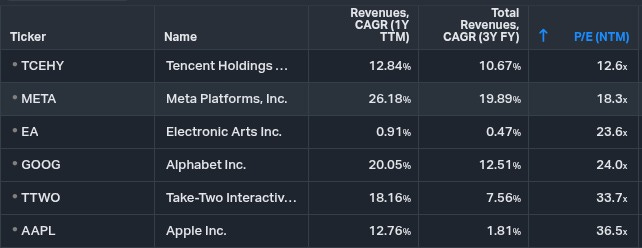
Meta is growing much faster than Tencent. Revenue is up 26% over the past twelve months and has compounded at nearly 20% annually over three years. It’s obviously a great business and probably deserves to trade at a slight premium, especially given that it’s U.S.-listed.
But is Meta really that much more dominant of a business than Tencent? I don’t think that’s obvious at all.
Google is growing faster too. Revenue is up 20% over the past year, helped by Cloud going absolutely nuts, and the business has compounded revenue at 12.5% annually over three years.
Tencent is at 10.7%.
That is a difference, but it’s not a massive one. Google trades at 24x forward earnings while Tencent trades at just 12.6x.
Google deserves the higher valuation. I just struggle to believe the underlying businesses are so different that one dollar of Google earnings should be worth nearly twice as much.
Then there is Apple.
Tencent and Apple grew revenue at almost the exact same rate over the past twelve months. Tencent grew 12.84%. Apple grew 12.76%.
Over the last three years, Tencent has compounded revenue at nearly 11% annually. Apple is below 2%.
Apple trades at a whopping 36.5x forward earnings.
Obviously Apple deserves a premium. It has one of the greatest consumer ecosystems ever built, an enormous global brand and a customer base that will happily spend $1,200 replacing a phone that still works perfectly fine.
I own no issue with Apple trading well above Tencent.
Almost three times the multiple is a lot, though…
Some of that gap comes from the premium the U.S. market awards its best technology companies. Some comes from the discount attached to anything Chinese. Put those two together and you end up with a pretty absurd spread.
Then there’s gaming
EA and Take-Two are not perfect comparisons either. Gaming is essentially the entire business for both of them. For Tencent, gaming is one piece of a much larger company.
Still, Tencent owns the largest gaming business in the world, so they’re worth including.
EA has barely grown revenue over the past three years and trades at 23.6x forward earnings.
Take-Two has grown faster recently, mostly as investors look forward to Grand Theft Auto VI and the earnings the company should produce once that arrives. The stock trades at 33.7x forward earnings.
I understand the argument for both.
What feels odd is that investors are willing to look several years into the future for Take-Two while giving Tencent very little credit for what it already owns and earns today.
Tencent already has an enormous and highly profitable gaming business. Honour of Kings, Peacekeeper Elite, League of Legends, Clash of Clans, Brawl Stars, Delta Force and a pile of other franchises spread across China and the rest of the world.
Then, on top of that, you get WeChat, advertising, cloud, payments, fintech and the investment portfolio.
The entire company trades at roughly half EA’s multiple and a little over one-third of Take-Two’s.
China deserves a discount. I don’t think it explains all of that.
The other thing that’s hard to capture in a comparison like this is just how good the business actually is.
Revenue growth and earnings multiples are useful, but they leave out the thing I care about most.
Tencent is a superb business.
WeChat is probably the best example of a true super app anywhere in the world. More than a billion people use it daily for messaging, payments, shopping, food delivery, transportation, entertainment, business and basically everything else.
I would put the moat around WeChat up against almost anything.
People are not leaving. Merchants are not leaving. The mini-program ecosystem is already there. The payments network is already there. Businesses have spent years building their operations around it.
I don’t know what would realistically disrupt that position at this point…
A better messaging app would not be enough. A competitor would need to recreate the social graph, payments layer, merchant network, mini-program ecosystem and all the little habits that have built up over more than a decade.
Good luck lol
That is what makes the valuation so hard for me to understand. Tencent is literally one of the best businesses in the world. It owns one of the most dominant consumer platforms ever created.
And then you have to consider management.
Pony Ma founded Tencent in 1998 and is still running it. Over that period, the company has built WeChat, become the largest gaming company in the world, created a giant payments and fintech business, invested in many of China’s best internet companies and returned enormous amounts of capital to shareholders.
Tencent’s management team belongs in the same conversation as the best teams running any major technology company.
They have repeatedly shown that they know when to invest, when to pull back, when to monetize outside holdings and when to buy their own stock.
The record is not perfect. Nobody’s is. But over nearly three decades, very few management teams have allocated capital this well across this many different businesses.
That deserves a premium too, or at least it should prevent the stock from trading like a questionable melting ice cube.
What would this trade at in the U.S.?
There is no way to know, obviously.
But I have a very hard time believing an American Tencent would trade anywhere close to its current valuation.
Imagine the pitch.
You have one of the most dominant consumer platforms in the world. More than a billion daily users. The largest gaming business. A growing advertising operation. Cloud, payments and fintech. A huge investment portfolio. Net cash. Double-digit revenue growth. Profit growing faster than revenue. A shrinking share count. One of the best management teams in technology.
Then add AI.
Tencent already has the users, merchants, advertisers, cloud customers, payments network and distribution. It does not need to build an audience for AI from scratch. It can push the technology into products people and businesses already use every day.
If that exact collection of assets were headquartered in California and listed on Nasdaq, investors would probably argue about whether it deserved 25x or 35x earnings.
I doubt anyone would suggest 12x was reasonable…
I’m not saying Tencent deserves Apple’s multiple. I’m not even sure it deserves Google’s.
But there is an enormous amount of room between 12.6x and the valuations the market gives these American companies.
At 16x earnings, Tencent would have roughly 27% upside from the multiple alone.
At 18x, the upside would be around 43%.
Even at 18x, Tencent would still trade below Google, Apple, EA and Take-Two. Investors would still be getting compensated for China. The valuation would just begin to resemble the quality of the business.
A Discount, Sure. This Much?
U.S. companies trade at a premium. They have deeper capital markets, more consistent foreign demand and far less political baggage.
Tencent operates in China, trades in Hong Kong and comes with risks that Meta, Google and Apple do not have. Some valuation gap is completely reasonable.
I just think the current gap has become far too wide.
Tencent is still growing. AI should create more opportunities across advertising, gaming, cloud and WeChat. The share count is coming down. The balance sheet is loaded. Management has proven itself over and over again.
Most importantly, the core business is about as difficult to disrupt as anything I have ever seen.
That combination should not trade like an average company.
Maybe Hong Kong leaves it cheap for another year. Wouldn’t exactly be shocking. But I have a hard time believing one of the best businesses and management teams in the world will permanently trade at such a massive discount to companies with similar, and in some cases worse, growth.
If Tencent traded in the U.S., the market would almost certainly value it like the superb business it is.
For now, we get the Hong Kong price.
I’m fine with that.
This article is for informational purposes only and does not constitute investment advice. I own shares of Tencent, and my own money is at risk. Always do your own work before making investment decisions.
I call Tencent the tech version of Berkshire. If you look at their investment portfolio it’s pretty impressive too and no one talks about that or takes that into account.
the only problem with Tencent stock today is the 100 share lot in Hong Kong with each share costing over HK$430. US$5,500 just to start playing...
Hopefully that changes with with the new HK lot rules that will be implemented.