
Coughlin Cap

Coughlin Cap

Tencent (0700.HK): The Best Business Nobody Wants

Tencent Holdings — $TCEHY $0700.HK

Brian Coughlin's avatar
Brian Coughlin
Jun 25, 2026
∙ Paid

Tencent is one of the best businesses in the world. I don’t think that’s a controversial thing to say.

It runs WeChat, and calling it a messaging app really undersells what it is. People message on it, pay with it, hail rides, order food, book doctor appointments, run entire small businesses, all without ever leaving it. More than a billion people open it every single day.

“WeChat has one of the widest moats I’ve ever seen.”
— John Huber, Saber Capital

There’s no real western equivalent and there isn’t a second app in China that comes close. That kind of position doesn’t get competed away. People have been trying to dislodge it for fifteen years and nobody’s gotten anywhere.

On top of that you’ve got the largest gaming business on the planet, an advertising machine that’s accelerating, a cloud and fintech arm, and a giant portfolio of stakes in other companies. The whole thing throws off enormous amounts of cash and earns very high returns on the capital it puts to work. This is about as high quality as large-cap tech gets, anywhere in the world.

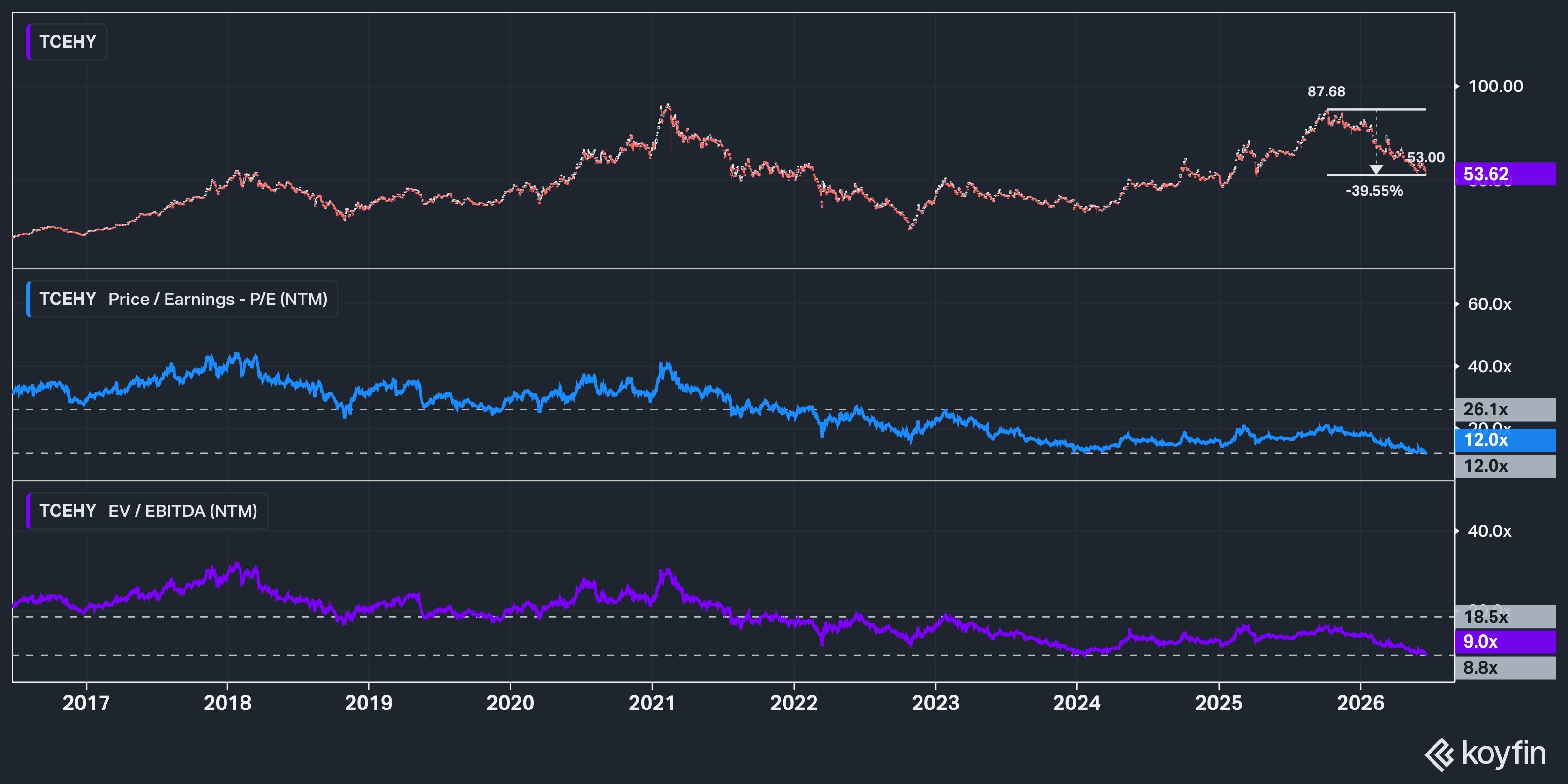
And the stock is sitting at 52-week lows. Down almost 40% from its October highs. Trading around ~12x forward earnings and ~9x EV/EBITDA.
If you want to try Koyfin, the tool I use for all my charts and research, you can get 20% OFF with this link.

I keep staring at this and I struggle to make it make sense.

Why is it so cheap?

I think it starts with the market Tencent trades in, but I want to be careful with how I frame this, because it’s not the same as 2022 or 2023.

Back then the whole China complex was basically radioactive. Nobody wanted anything. Mainland stocks, Hong Kong stocks, ADRs, internet platforms, consumer names, property-adjacent names, all of it got thrown into the same uninvestable bucket.

This time is a little different.

Mainland China stocks have actually been acting pretty well. A-shares have rallied, AI names have ripped, and there’s plenty of speculative energy in parts of the domestic market. Some of the mainland AI stuff honestly looks quite frothy at the moment. Money is chasing semiconductors, robotics, AI infrastructure, domestic replacement, and anything that smells like policy support.

Hong Kong, on the other hand, has been left for dead.
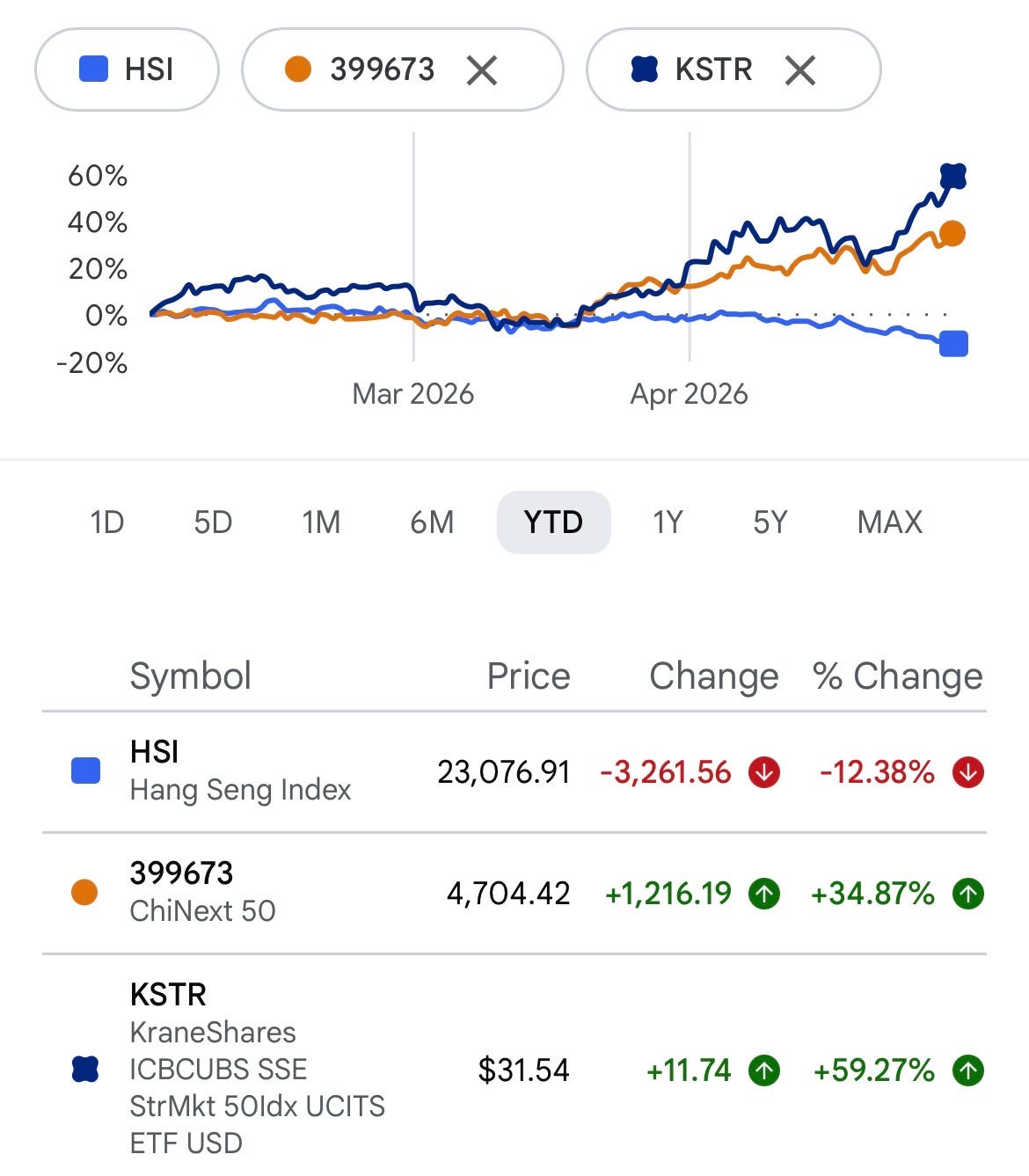
Tencent, Alibaba, Meituan, Kuaishou, JD, and the rest of the group have been trading like investors want nothing to do with them. Some of that is macro. China’s economy has been sluggish and the consumer recovery hasn’t been nearly as strong as people hoped, myself included.

Property is still a drag, confidence is weak, and consumers remain very cautious.

I do think China eventually comes out of this, though more stimulus is probably needed. Right now the economy feels stuck in this odd half-recovery where certain parts are fine, certain parts are even hot, and the consumer still looks tired.

Coughlin Cap is a reader-supported publication. To receive new posts and support my work, consider becoming a free or paid subscriber.

Then there’s the flow problem.

Money that might normally find its way into Hong Kong internet is getting pulled toward mainland AI instead. A domestic investor can look at a semiconductor name ripping in Shanghai or Shenzhen, then look at Tencent grinding lower in Hong Kong, and the short-term choice becomes pretty obvious.

Why sit in a cheap mega-cap internet stock when the party is happening somewhere else?

I get it.

But these rotations always feel permanent while they’re happening. The hated group gets cheaper, the crowded group gets more crowded. Then at some point the easy money in the hot stuff gets made, the valuation gap gets stupid, and people start looking around again.

Tencent is on the wrong side of that rotation right now. That’s painful if you own it. It’s also why the opportunity exists.

The other piece is the AI perception thing.

There’s been a narrative for a while that Tencent is behind in AI. And to be fair, a year ago that had some truth to it. Tencent was slow and cautious at the start of the AI boom while Alibaba, ByteDance, DeepSeek, Baidu, Moonshot, and a bunch of others were moving as fast as possible to cement their place as AI leaders

I don’t think that’s a fair read anymore.

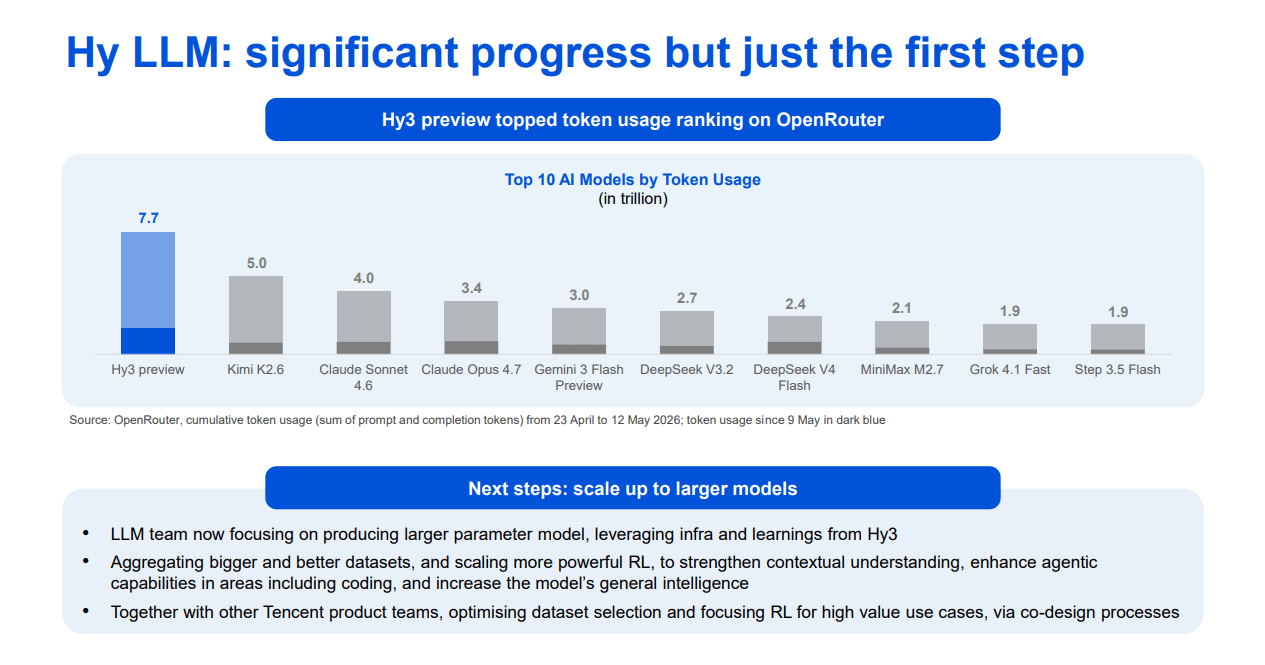
Tencent hired Yao Shunyu, a former OpenAI researcher, as its Chief AI Scientist last year, and reorganized the whole AI effort around Hunyuan. Then they launched the Hy3 preview model in April, and management has been clear that it’s now good enough to use across real products.

It’s been the top-ranked model on OpenRouter by token usage since late April, which is about as real-world a measure of developer adoption as you’ll find.
I’m not going to pretend I can tell you which Chinese model will be the best two years from now. But I also don’t think that’s really the Tencent story.

The advantage for Tencent is where the AI can go. They already own the place where people spend their time. That’s the part I care about.

It reminds me a little of Apple. Everyone has spent the last couple of years yelling that Apple is behind in AI, and maybe that’s true. But Apple has the device in your pocket, the operating system, the default apps, the payments layer, and the customer relationship. Being late matters a lot less when you already control the surface area.

Tencent has a version of that in China through WeChat.

Tencent is one of the best businesses in the world. I don’t think that’s a controversial thing to say.

It runs WeChat, and calling it a messaging app really undersells what it is. People message on it, pay with it, hail rides, order food, book doctor appointments, run entire small businesses, all without ever leaving it. More than a billion people open it every single day.

“WeChat has one of the widest moats I’ve ever seen.”
— John Huber, Saber Capital

There’s no real western equivalent and there isn’t a second app in China that comes close. That kind of position doesn’t get competed away. People have been trying to dislodge it for fifteen years and nobody’s gotten anywhere.

On top of that you’ve got the largest gaming business on the planet, an advertising machine that’s accelerating, a cloud and fintech arm, and a giant portfolio of stakes in other companies. The whole thing throws off enormous amounts of cash and earns very high returns on the capital it puts to work. This is about as high quality as large-cap tech gets, anywhere in the world.

And the stock is sitting at 52-week lows. Down almost 40% from its October highs. Trading around ~12x forward earnings and ~9x EV/EBITDA.

If you want to try Koyfin, the tool I use for all my charts and research, you can get 20% OFF with this link.

I keep staring at this and I struggle to make it make sense.

Why is it so cheap?

I think it starts with the market Tencent trades in, but I want to be careful with how I frame this, because it’s not the same as 2022 or 2023.

Back then the whole China complex was basically radioactive. Nobody wanted anything. Mainland stocks, Hong Kong stocks, ADRs, internet platforms, consumer names, property-adjacent names, all of it got thrown into the same uninvestable bucket.

This time is a little different.

Mainland China stocks have actually been acting pretty well. A-shares have rallied, AI names have ripped, and there’s plenty of speculative energy in parts of the domestic market. Some of the mainland AI stuff honestly looks quite frothy at the moment. Money is chasing semiconductors, robotics, AI infrastructure, domestic replacement, and anything that smells like policy support.

Hong Kong, on the other hand, has been left for dead.

Tencent, Alibaba, Meituan, Kuaishou, JD, and the rest of the group have been trading like investors want nothing to do with them. Some of that is macro. China’s economy has been sluggish and the consumer recovery hasn’t been nearly as strong as people hoped, myself included.

Property is still a drag, confidence is weak, and consumers remain very cautious.

I do think China eventually comes out of this, though more stimulus is probably needed. Right now the economy feels stuck in this odd half-recovery where certain parts are fine, certain parts are even hot, and the consumer still looks tired.

Coughlin Cap is a reader-supported publication. To receive new posts and support my work, consider becoming a free or paid subscriber.

Then there’s the flow problem.

Money that might normally find its way into Hong Kong internet is getting pulled toward mainland AI instead. A domestic investor can look at a semiconductor name ripping in Shanghai or Shenzhen, then look at Tencent grinding lower in Hong Kong, and the short-term choice becomes pretty obvious.

Why sit in a cheap mega-cap internet stock when the party is happening somewhere else?

I get it.

But these rotations always feel permanent while they’re happening. The hated group gets cheaper, the crowded group gets more crowded. Then at some point the easy money in the hot stuff gets made, the valuation gap gets stupid, and people start looking around again.

Tencent is on the wrong side of that rotation right now. That’s painful if you own it. It’s also why the opportunity exists.

The other piece is the AI perception thing.

There’s been a narrative for a while that Tencent is behind in AI. And to be fair, a year ago that had some truth to it. Tencent was slow and cautious at the start of the AI boom while Alibaba, ByteDance, DeepSeek, Baidu, Moonshot, and a bunch of others were moving as fast as possible to cement their place as AI leaders

I don’t think that’s a fair read anymore.

Tencent hired Yao Shunyu, a former OpenAI researcher, as its Chief AI Scientist last year, and reorganized the whole AI effort around Hunyuan. Then they launched the Hy3 preview model in April, and management has been clear that it’s now good enough to use across real products.

It’s been the top-ranked model on OpenRouter by token usage since late April, which is about as real-world a measure of developer adoption as you’ll find.

I’m not going to pretend I can tell you which Chinese model will be the best two years from now. But I also don’t think that’s really the Tencent story.

The advantage for Tencent is where the AI can go. They already own the place where people spend their time. That’s the part I care about.

It reminds me a little of Apple. Everyone has spent the last couple of years yelling that Apple is behind in AI, and maybe that’s true. But Apple has the device in your pocket, the operating system, the default apps, the payments layer, and the customer relationship. Being late matters a lot less when you already control the surface area.

Tencent has a version of that in China through WeChat.

They’re now testing Xiaowei, an AI assistant built into WeChat that you can use by text or voice. It can tap into mini-programs and actually complete tasks inside the ecosystem, and WeChat already has mini-programs for food delivery, ride-hailing, local services, shopping, payments, and basically everything else. A full rollout is supposedly coming later this year.

You can see where this goes.

Tencent doesn’t need every person in China to download some separate AI app every morning. The users, the merchants, the payments, and the workflows are already sitting inside WeChat. If they can put a useful assistant on top of that, the path to making money off it is a lot more obvious than it is for a standalone chatbot.

And the AI benefits are already showing up in the actual business. Similar to what we’ve seen from Meta, advertising is the cleanest example.

Marketing Services revenue grew 20% in Q1, up from 17% the quarter before, and Tencent pointed to its AI-driven ad recommendation model as the reason performance and pricing improved. That’s exactly where AI should be earning its keep for a business like this, and it’s already flowing straight through to revenue.

Business Services also grew 20%, helped by cloud demand including AI-related services and a better pricing environment.

So AI is clearly already helping the ad business, already helping cloud, and already getting pushed into products people actually use.

The business is compounding and the stock doesn’t care.

Which brings me to the part that makes the stock action feel so disconnected from reality.

Full year 2025 was strong. Revenue grew 14% to RMB 751.8 billion, gross profit grew faster than that and reached RMB 422.6 billion, and non-IFRS profit attributable to shareholders rose 17% to RMB 259.6 billion. Full-year gross margin pushed above 56%.

Does that sound like dying/broken business to you? Anyways…

Q1 was more of the same. Revenue was up 9% to RMB 196.5 billion, gross profit up 11%, and free cash flow grew 20% to RMB 56.7 billion. IFRS profit attributable to shareholders jumped 21%, and the non-IFRS figure was up 11%.

The headline revenue growth looked a little softer than it really was because of Lunar New Year timing in games. Some revenue recognition shifted out of Q1 and into Q2.

Underneath that, the gaming business still looks exceptionally healthy. Domestic game gross receipts grew at a teens rate, Honour of Kings and Peacekeeper Elite keep performing, Delta Force has moved into that evergreen category Tencent loves, and international games revenue grew 13%.

So the stock looks ugly, but the business obviously doesn’t…

This is the part I keep coming back to. If Tencent were trading at 25x earnings, we could have a real debate about whether growth is good enough, whether AI spending pressures margins, whether China macro is too weak, whether the gaming cycle is peaking, all of it.

But it’s trading around ~12x forward earnings.

At that valuation I don’t need perfection. I need the business to keep compounding earnings, keep generating cash, and keep retiring shares. That seems like a pretty reasonable ask.

And Tencent is absolutely retiring shares.

The buyback is one of my favorite parts of owning this.

Tencent has been in the market constantly. A million shares here, a million there, day after day after day.

And this has been true for a while now. Tencent has not been shy about buying its own stock when management thinks the price is wrong. Over the past decade, they’ve generally been very smart with capital. They’ve built the core business, made great outside investments, and now they’re using a lot of that cash flow to buy back stock while the market is throwing the baby out with the bathwater.

The share count is actually coming down.

They bought back something like HK$112 billion of stock in 2024, or roughly US$14.4 billion, followed by another HK$80 billion in 2025, or about US$10.3 billion. In Q1 2026 alone, they bought back 12.7 million shares for HK$7.6 billion, just under US$1 billion.

After a new repurchase mandate was approved in May, they kept right on going. Through the June 23 filing they’d repurchased another 26.3 million shares under that mandate, putting them at roughly 39 million shares year-to-date. On June 23 alone, they bought back 1.19 million shares for about HK$501 million, or roughly US$64 million.

I love seeing this.

Pony Ma founded Tencent in 1998 and he’s still there. His capital allocation record over that stretch is about as good as it gets in technology. So when Tencent is using this much cash to retire shares at these prices, it’s worth while to pay attention.

Buybacks don’t put some magic floor under a stock. Hong Kong can keep going down for reasons that make everyone question their life choices, and I’m very aware of that. But over a few years this starts to add up. If earnings keep growing and the share count keeps falling, per-share value rises even if the multiple stays in the gutter. And if the multiple re-rates on top of that, you get paid twice.

That’s why I like the buyback here so much. They’re not buying at 30x because some capital-return box needs checking. They’re buying at a depressed valuation while sentiment is awful.

I think Buffett would approve of this one.

I’d much rather see this than watch something like PDD sit on a mountain of cash while shareholders wait around hoping management eventually remembers they exist.

Tencent is telling you what it thinks of the current price. And it can afford to do it.

At the end of Q1, Tencent had over US$66 billion of total cash and short-term investments on the balance sheet, RMB 146.9 billion of net cash, or roughly US$20 billion, plus listed investee stakes worth RMB 547.1 billion and unlisted stakes carried at RMB 365.1 billion. Together, those stakes were worth more than RMB 912 billion, or about US$127 billion.

I’m not treating that whole investment portfolio like cash. That would be too aggressive. Some of it deserves a discount, some of it is illiquid, and some of it may never get monetized the way investors want.

But come on.

This is a giant asset base sitting behind a business that already throws off enormous cash flow. Tencent can invest heavily in AI, keep buying back stock, pay a dividend, and still run a very strong balance sheet. That’s a great problem to have.

Where I land

I think the math is as simple as it gets, and honestly that’s what I like about it.

You’re paying about ~12x forward earnings for one of the best businesses in the world. Earnings growing low-to-mid double digits. The share count is shrinking underneath you because the company is buying back stock every day. There’s over $66 billion of cash and short-term investments on the balance sheet. AI is a real and growing tailwind, and the management team is one of the best in tech.

For this to not work you basically need earnings growth to stop. I just don’t see how that happens given what’s going on with advertising, gaming, cloud, and the AI integration. I have almost no doubt they’ll keep compounding earnings at double digits.

So either the multiple stays permanently depressed and you still make money because the earnings grow and the share count drops. Or sentiment eventually thaws and the stock drifts back toward the 18-20x it spent most of its life trading at and you do very well. Both paths work, but the second one pays you more.

It’s always tough trying to catch a falling knife… China can stay cheap longer than feels reasonable, and I’m not calling the bottom here. But when I look at one of the best companies in the world at a value multiple, with the guy who built it buying shares every day, near 52-week lows, I just don’t feel like I need to overthink it.


Disclaimer: This article is for informational purposes only and does not constitute investment advice. Always do your own due diligence before making investment decisions.

© 2026 Brian Coughlin · Privacy ∙ Terms ∙ Collection notice
Start your SubstackGet the app
Substack is the home for great culture