


Disclaimer: I’m just one investor thinking out loud. This isn’t financial advice. Do your own work before buying or selling anything.
The number everyone is using to explain why China loses from the Iran war is off by two orders of magnitude. And nobody seems to care.
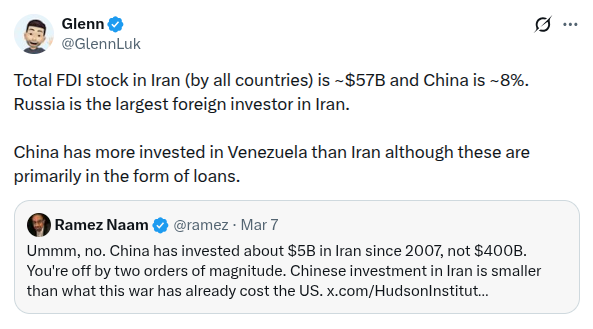
The Hudson Institute posted that China “invested over $400 billion in long-term infrastructure and energy investments in Iran.” The Washington Post literally built an entire opinion piece around it. And now my feed is full of people confidently explaining how China is fucked…
And it’s complete fiction.
Ramez Naam called out the bullshit: actual Chinese investment in Iran since 2007 is about $5 billion. Not $400 billion. Five. The $400 billion comes from a framework agreement in 2021 that was basically a press release with a big number stapled to it. Nobody signed a check.
Glenn Luk piled on and pointed out that total FDI in Iran from every country on earth is only about $57 billion. China’s share is roughly 8%. Russia is actually the largest foreign investor in Iran, not China. China has more money in Venezuela than Iran.
So “China’s enormous bet on Iran” is a $5 billion position in an $18 trillion economy. But nobody checks because the big number makes for a better headline and it fits the story everyone already wants to tell.
I’m not a geopolitics expert. I want to be clear about that upfront. I’m just a guy who owns a few Chinese stocks and has been following this stuff closely for over a year because I think there’s opportunity, I also enjoy being contrarian.
But I’ve been paying close attention, and what I keep running into is this remarkably massive gap between the story the market is telling about China and what’s actually happening if you just... look.
The US and China are getting along. Like actually getting along. And I think the relationship between these two countries is on a better trajectory right now than at any point in the last decade.
I know. I know. We’re in the middle of a shooting war in the Middle East. The think tanks are running victory laps about how “China’s grand strategy has failed.” Matt Pottinger is on Bloomberg explaining his “Axis of Chaos” theory. The energy/oil crowd on Fintwit has decided the whole thing is really a 4D chess move to squeeze Beijing.
I think they’re all operating from a framework that stopped being accurate about a year ago.
I cover the companies, themes, and macro trends I think matter most for investors right now. Paid subscribers get full portfolio visibility, all research, and ongoing updates as positions evolve.
Here’s some recent work:


The old framework is broken
For years, the default assumption has been that US-China is adversarial and getting worse. Decoupling, tech war, trade war, Taiwan. Every single event gets run through this lens. Something happens in the Middle East? Must be about China. New tariff? Escalation. Military exercise? Provocation.
The framing is always confrontation, always zero-sum.
And for a while that was mostly right. The tariffs, the Huawei ban, the chip export controls, the balloon incident. It was ugly. If you were long Chinese equities through that period, you know exactly what I’m talking about.
But something shifted in the past year and most people haven’t updated their model. They’re still running the old playbook.
We saw the tariff escalation get ugly enough that both sides stared into the abyss and didn’t like what they saw. By early 2025, tariffs on Chinese goods had been ratcheted up to 57%. Trump was threatening 100%. China had fired back with retaliatory tariffs, slapped export controls on rare earths, gallium, germanium, and antimony, and launched investigations into US semiconductor companies.
It was spiraling and it was getting stupid.
Then the Busan summit happened in October. And for some reason, nobody talks about the actual substance of what they agreed to.
China suspended all retaliatory tariffs imposed since March 2025. Lifted rare earth export controls for a year. Opened up exports of gallium, germanium, and critical minerals to US end users. Committed to buying 12 million metric tons of US soybeans immediately, followed by 25 million metric tons annually for the next three years. Dropped investigations into US chip companies. Resumed trade from Nexperia’s China facilities.
In return, the US cut the overall tariff rate from 57% to 47%, extended Section 301 exclusions, and suspended the Affiliates Rule that would have expanded export controls to subsidiaries of blacklisted firms.
Read that list again... That’s a comprehensive de-escalation across trade, agriculture, critical minerals, and technology. Both sides agreed to renegotiate annually, which means there’s a structural incentive to keep the relationship stable going forward. And yet nobody on my timeline seems to think it matters.
Since Busan, Trump has accepted an invitation to visit Beijing March 31 to April 2. There are reports of a deal for up to 500 Boeing aircraft being lined up as a deliverable. The Supreme Court struck down Trump’s IEEPA tariffs in February, which further weakened Washington’s ability to escalate unilaterally. Trade negotiators are meeting in mid-March to prep for the summit. Senior officials are now talking about four leader-level meetings in 2026. Four. That would be unprecedented in the history of the relationship.
And it’s not just the US making nice. There’s been a parade of Western leaders heading to Beijing that honestly feels like a velvet rope situation at this point. Macron visited in December with six cabinet ministers and 35 corporate executives. Starmer in January. Canada’s Carney in January. Germany’s Merz in February with 30 executives from Mercedes-Benz, BMW, and other major firms. China overtook the US to become Germany’s largest trading partner again in 2025. German investment in China hit a four-year high.
These aren’t countries that think decoupling is working. They’re hedging, and they’re hedging toward Beijing.
Oh, and Wang Yi came out just yesterday (while a war is happening that’s supposedly all about squeezing China) and said 2026 is a “big year” for China-US relations and that the agenda for high-level exchanges is “already on our table.” This is the Chinese Foreign Minister, on the record, telling you the relationship is moving forward.
But sure, Cold War 2.0. Any day now.
Quick shameless plug: If you want to try Koyfin, the tool I use for all my charts and research, you can get 20% OFF any paid plan with this link.
The Iran narrative is Exhibit A of the old thinking
This is where it gets fun, because the folks claiming Iran is really about China is a perfect example of people using the old adversarial framework to interpret something that clearly doesn’t fit it anymore.
If the US is engineering a geopolitical squeeze on China, why is Trump flying to Beijing at the end of this month to sign a deal? Why are trade negotiators meeting in mid-March while bombs are falling on Tehran? Why did we just cut tariffs, ease rare earth restrictions, and agree to four summits? You can’t be simultaneously waging economic warfare against a country and planning signing ceremonies with its president. Pick one.
And the numbers behind the China investment in Iran fall apart even faster than the logic.
I already walked through the $400 billion fiction. Here’s the rest…
The oil relationship is in fact real. China bought about 1.38 million barrels per day of Iranian crude in 2025. Sounds like a lot. But flip the numbers around and it’s about 13% of China’s total imports. Thirteen percent. And most of it is bought by small independent refiners in Shandong province through shadow fleets, relabeling it as Malaysian to dodge sanctions. The big state-owned firms won’t touch it.
China has been diversifying away from Iranian crude since last June. They’ve ramped up Brazilian imports by 28%, bought more from Russia, and stockpiled reserves at five times the rate of the prior year. They saw this coming. Or at least they hedged like they did.
When 80-90% of your oil exports go to one buyer and that buyer accounts for 8% of your total foreign investment and has been quietly replacing you for months, you’re not their strategic partner. You’re their discount gas station. Iran needs China way more than China needs Iran, and that’s not up for debate.
And the idea that the US would deliberately tank the economies of South Korea, Japan, India, and Europe — its own allies — just to make China’s oil bill slightly more expensive?
Look at the scoreboard…
KOSPI fell 18%. Japan fell 6%. Europe fell 3%. China’s CSI 300? Down 1.4%. Every US ally in the region got smacked harder than China did. But sure, tell me more about how China is the big loser here.
Does deliberately cratering your allies’ markets sound like a Donald Trump move? The guy who celebrated falling gas prices every other week? If you want to pressure China on energy, there are about 50 tools you could use before stating a war and closing the worlds most important shipping lane.
Tighten sanctions enforcement. Go after the shadow fleet. Secondary sanctions on the teapots. You don’t burn down your neighbor’s house to kill a spider.
Taiwan is Exhibit B
While we’re at it, let’s talk about the other thing every armchair geopolitics expert on the internet is absolutely certain about.
Xi is going to invade Taiwan. It’s imminent. The Iran war is the perfect distraction. This is it. For real this time.
I’ve been hearing this for years. Every few months a new article drops from a very serious person at a very serious institution explaining why this is finally the year China makes its move on Taiwan. And every few months it doesn’t happen. And then the same people write the same article again six months later with a slightly different headline.
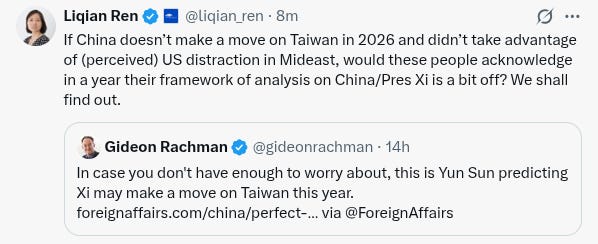
The latest round got kicked off by a Foreign Affairs piece from Yun Sun predicting Xi may make a move in 2026, which Gideon Rachman at the FT helpfully amplified with “in case you don’t have enough to worry about.” Thank you Gideon, very helpful.
Liqian Ren — someone I follow closely and respect a lot when it comes to China — put it perfectly on X:
“If China doesn’t make a move on Taiwan in 2026 and didn’t take advantage of US distraction in the Mideast, would these people acknowledge in a year their framework of analysis on China/Pres Xi is a bit off? We shall find out.”
That’s exactly my point. These predictions never come with accountability. The invasion is always six months away. When it doesn’t happen, nobody goes back and says “huh, maybe my model is wrong.” They just write another piece explaining why next time is the real one.
There’s a few things the fear-mongers keep conveniently leaving out.
Xi just purged nine more military officials, including the ground forces commander who literally ran the Taiwan invasion drills. This is part of a military housecleaning that’s been ongoing for over a year and has gutted the PLA’s most experienced leadership. CSIS — not exactly a pro-China outfit — published research showing these purges have already degraded China’s ability to conduct exercises near Taiwan.
In 2024, China reacted to what it considered provocative behavior from Taiwan within days. By 2025, response time had stretched to 12-19 days. That’s not a military gearing up for the most complex amphibious operation in human history. That’s a military in the middle of reorganizing itself.
The 2026 National Defense Strategy doesn’t mention Taiwan. Xi’s own government work report this week still leads with “peaceful reunification” as the operative phrase — the same language every Chinese leader has used going back decades. If Xi intended to signal a shift toward force, he would have changed the wording. He didn’t.
And the other thing nobody on Fintwit seems to want to grapple with: the political trends in Taiwan are actually moving in Beijing’s favor right now. The ruling DPP has low approval ratings, a deadlocked legislature, and internal party fights. The opposition KMT is more open to engagement with the mainland.
Why would Xi risk a catastrophic military gamble — one that would make Russia’s invasion of Ukraine look like a cakewalk logistically — when he’s gaining ground without firing a shot?
A failed invasion would be existential for Xi. No Chinese leader could survive a bungled attempt at taking Taiwan, and Xi knows it. He hasn’t been reckless in 13 years. He’s not going to start now, especially not when he’s about to host the American president for a state visit and the trade relationship is the healthiest it’s been in a decade.
Taiwan is a real long-term risk. I’m not waving it away. But the idea that it’s imminent doesn’t line up with anything that’s actually happening on the ground. It just makes for a good headline and a scary tweet.
What’s actually going on
I’ll admit it’s a pretty simple view. But in my experience, simple is usually closer to correct than clever.
The US and China are the two biggest economies and the two biggest militaries on the planet, and both sides have slowly, grudgingly, in their own stubborn ways, come around to the realization that they need each other more than either one wants to admit out loud.
The world works better when these two countries are talking, making deals, and functioning like adults. It works worse when they’re threatening each other. I don’t think that’s a controversial opinion. I think it’s obvious. And I think Trump, whatever else you think about him, actually gets it on a gut level. He’s a deal guy. He wants to negotiate. He’s not looking for a fight with China. He’s looking for a win he can put on TV.
The Iran war makes this even clearer. You cannot be in a shooting war in the Middle East, burning through munitions, deploying carrier strike groups, spending billions — and simultaneously pick a fight with the other superpower. That math doesn’t work. Nobody fights on two fronts against the world’s two largest militaries at the same time. The last time someone tried something like that it didn’t go well for them and we read about it in history books.
So I don’t think the war pushes the US and China apart. It pulls them together. Washington needs Beijing to not arm Iran, to not escalate on Taiwan while the military is pinned to the Gulf, and to keep the trade relationship stable while the US deals with its mess in the Middle East.
China has every reason to do exactly that. Both sides benefit from the relationship working right now, and both sides know it.
The broader point
I think there’s a version of the next few years that looks a lot different from what most people expect, and almost nobody is positioned for it.
In that version, the US and China keep moving toward a functional relationship — not because they love each other or because the tensions magically disappear, but because the alternative is too dangerous and too expensive for both sides.
Trump keeps doing deals, Xi keeps showing up, the tariffs keep coming down, and the geopolitical discount on Chinese equities gradually fades as the market realizes that Cold War 2.0 isn’t actually happening.
In that version, the Iran war becomes a catalyst for this trend rather than a contradiction of it, because Washington needs Beijing too much right now to pick additional fights, and Beijing is smart enough to take the win.
I know this is an optimistic view. And I know the default in markets and media right now is pessimism about everything involving China. There are real risks and I’m not dismissing any of them. I could be wrong about all of this. It wouldn’t be the first time…
But I also know that 90% of Western investors and commentators have a reflexive bias against anything China-related. It’s baked into how the media covers it, how the think tanks frame it, and how the market prices it. That bias has been a headwind for years.
Biases create mispricings though, and mispricings create opportunities.
I’ve been watching this relationship evolve for over a year now. I’ve watched the rhetoric soften, the deals accumulate, and the summits multiply. And I’ve watched the market completely ignore all of it because the old adversarial framework is so deeply embedded in how people think about China that they literally can’t see what’s right in front of them.
I think that gap between narrative and reality is one of the most interesting opportunities in markets right now. Not just because Chinese stocks are cheap (though they are) but because the reason they’re cheap is based on a view of the world that I think is becoming less true by the month.
The two biggest economies on earth are getting along better than they have in a long time, and most people haven’t noticed. I think they soon will.
Disclaimer: I’m just one investor thinking out loud. This isn’t financial advice. Do your own work before buying or selling anything.
I have a personal portfolio that only includes ETF’s, separate from other accounts. Right now the majority are Chinese ETF’s. I’m betting on China as a whole. I think you’re dead on; we’ve been taught in America that China is the “enemy”, same with Russia, our whole lives. Besides all the big companies that everyone knows about, there are some real deep value gems in China right now.
Chinese ADR stocks are rebounding strongly, an early sign of P/E Recovery in 2026?