



AK | Unfair Advantage Capital and I have been talking about Domino’s lately and decided to write this one together. He writes Unfair Advantage, and we’ve been comparing notes on the business and what the stock could return from here.
For me, the valuation and buybacks were the initial draw. If you read my recent Dropbox post, that probably won’t surprise you. I do like a good share cannibal, particularly when the stock looks cheap. There’s a lot more to Domino’s than I’d initially appreciated, which made it a good company for us to work through together.
Domino’s Pizza serves almost a billion pizzas a year. But Domino’s is not just a pizza chain. Look under the lid, and you will find a story of networks, supply chains, behavioral economics and incentives.
The business was started in 1960 by two brothers, Tom and James Monaghan. Tom pioneered the delivery and franchise model that Domino’s is now known for. While almost everyone is familiar with Domino’s pizza and its unmistakable logo, the business remains somewhat poorly understood.
The stock has fallen a long way from its highs, which brings the valuation into the discussion. When you look under the Domino’s hood, you find a durable, low-cost machine operating in an environment where its competitors are struggling. We think Domino’s has room to take more share of the pizza business in the US and internationally.
The stock is now nearly ~40% below its highs. Looking at it today, though, I do wonder whether investors have become too pessimistic.
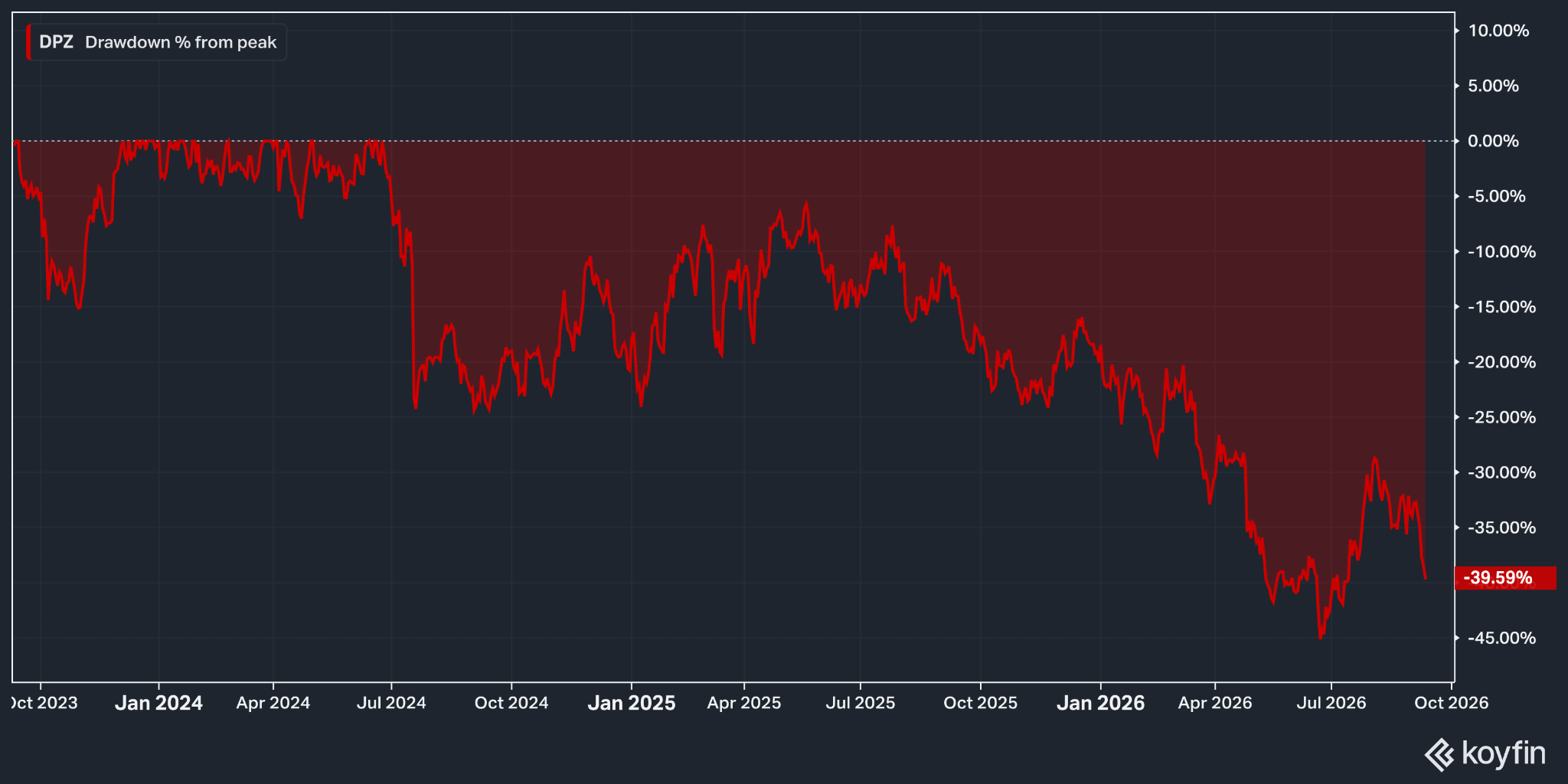
Domino’s still has the scale to keep prices low, and we think it has room to take more share as competitors struggle. If the business holds up, a stretch like this also gives the company a chance to retire more shares with the same amount of cash. Given my fondness for buybacks, you can probably see why I wanted to spend some time on this one.
Domino’s business model
Domino’s looks simple from the street. You order a pizza. A store makes it. A driver brings it.
Underneath, three systems work as one:
A supply chain that buys and prepares ingredients
A franchise network that owns and runs the stores
A technology platform that links the customer, kitchen and driver
The goal: sell more pizzas, keep the price low and get each order to you fast.
The franchise model
Franchisees run about 99% of Domino’s stores. The company keeps a small group of corporate stores, mostly to test new ideas. Outside the United States, the network is fully franchised.
A US franchisee generally pays a royalty of 5.5% of sales, with technology fees charged separately. International royalties average around 3%. If a US store sells you a $20 pizza, the parent company collects about $1.10 in royalties before the franchisee pays its other expenses.
Franchisees also help fund the advertising. US stores generally contribute 6% of sales to the national advertising fund, giving the system a marketing budget that an independent pizza shop would struggle to match.
At the end of 2025, Domino’s had roughly 7,200 US stores and 15,000 international stores. Together, they generated just over $20 billion in annual retail sales.
The supply chain
Domino’s supplies ingredients, from dough, meat and vegetables to cheese, to its franchise stores through its supply-chain network. The supply-chain business generates roughly $3 billion in annual revenue. In FY25, $193 million was shared with participating US and Canadian franchisees through the profit-sharing program.
Cheese is the largest food cost in a pizza. Domino’s applies a fixed mark-up to the cheese it sells to franchisees. That way, even if the cheese price moves, revenue and percentage margins can fluctuate while the dollar mark-up per unit remains the same.
Scale drives the flywheel. More stores create larger orders. Larger orders cut the cost per ingredient. Lower ingredient costs and profit sharing put more cash in a franchisee’s pocket. That makes the network harder to leave.
The profit-sharing cheque changes the economics of that store.
That money goes back into the economics of the franchise network. It helps make the stores more profitable and gives franchisees another reason to keep buying through Domino’s supply chain.
Fortressing
Domino’s began doing something that looked wrong. Alongside entering new markets, it started to split existing territories and open more stores in the same area.
You might ask: does that not steal sales from the old stores?
It can.
Domino’s called this strategy fortressing because the new store can strengthen the whole territory.
Carryout gets easier. Customers will not drive far for a pizza. A closer store puts more households within a short trip of Domino’s. With carryout, the store does not have the cost of delivering the order.
Delivery gets faster. Shorter routes let one driver carry more orders each hour. More stores in the same territory can shorten delivery times, lower the labour cost per pizza delivered and get the pizza to you hotter.
It makes life harder for competitors. In a neighbourhood where there are already three Domino’s stores, a new Papa John’s franchise may have a harder time competing on delivery speed and store economics.
People and operations
Opening stores closer together helps with delivery times. You still need people who can run them properly, though. A Domino’s store can have a pizza ready for delivery in six or seven minutes, and keeping that pace across roughly 22,000 stores depends on the people running them.
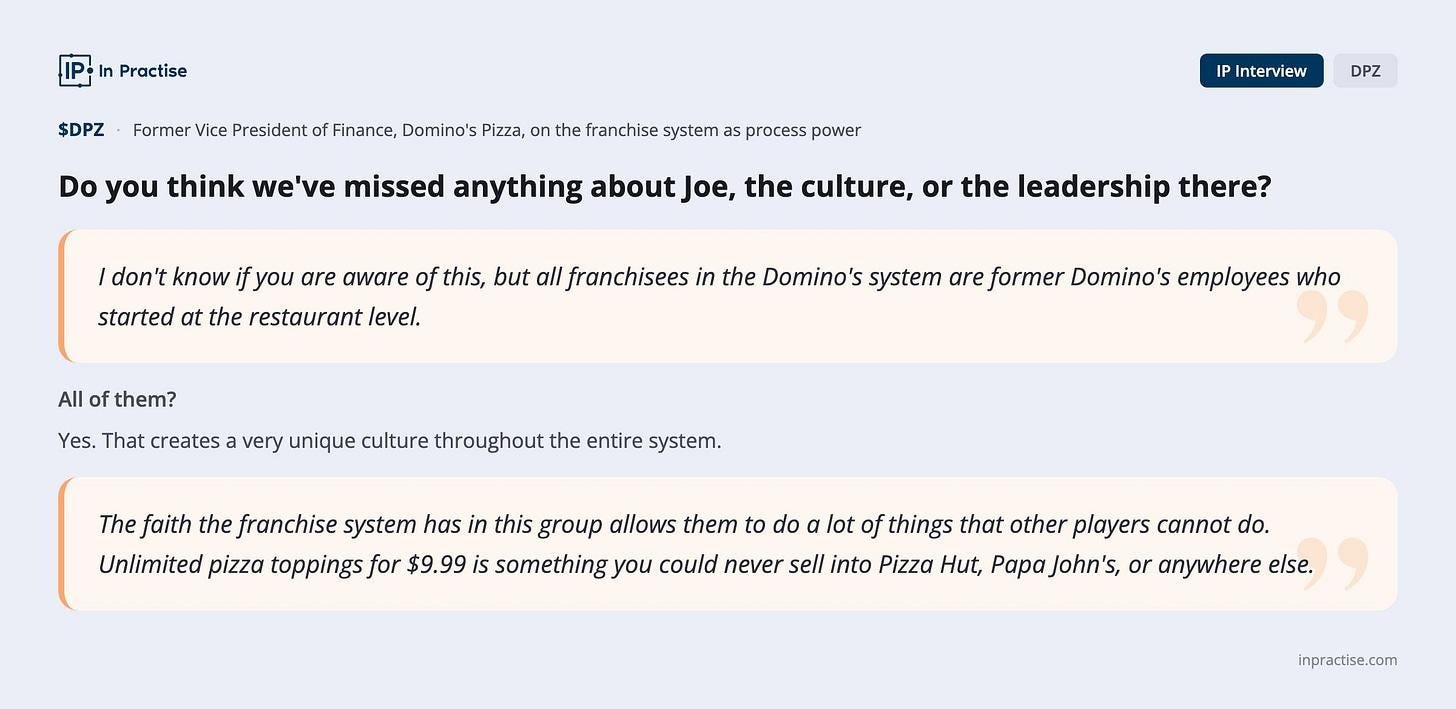
That helps explain why you can’t just show up with $500,000 and buy a US Domino’s franchise. The company wants owners who have already worked inside the system. A future franchisee must first run a store and prove they can follow the operating model.
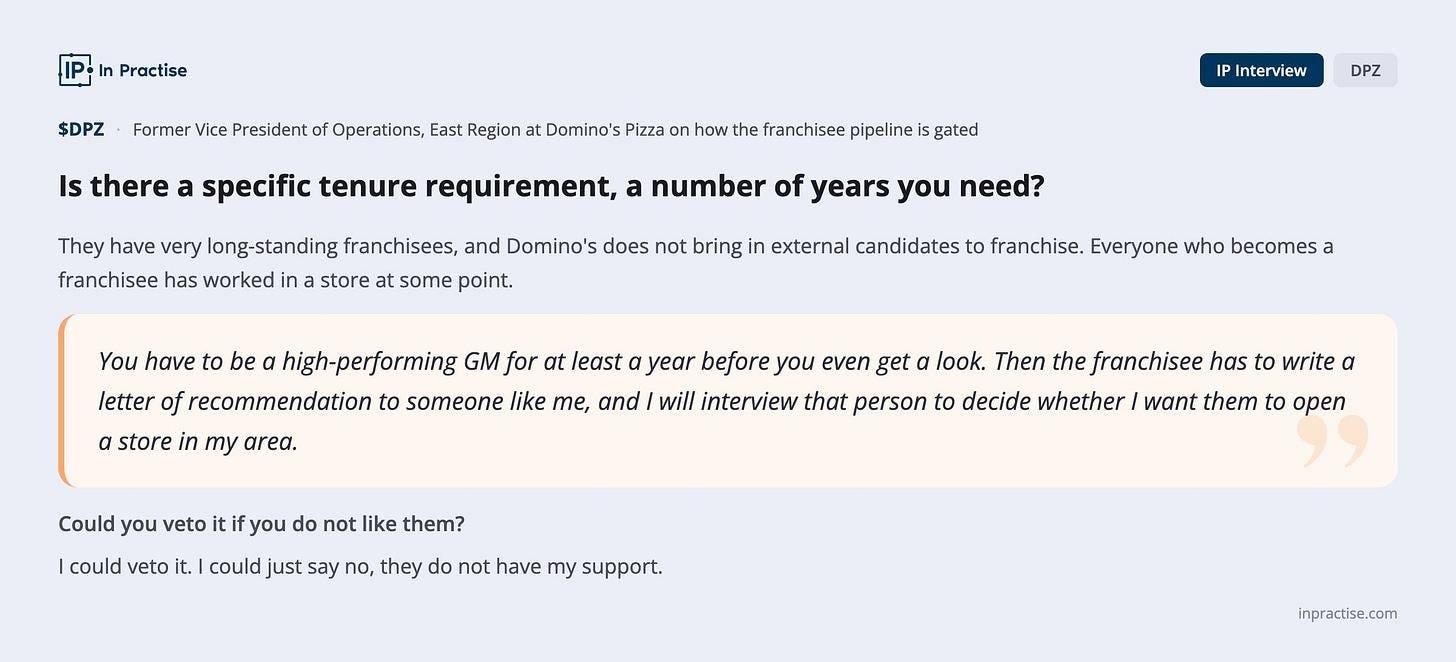
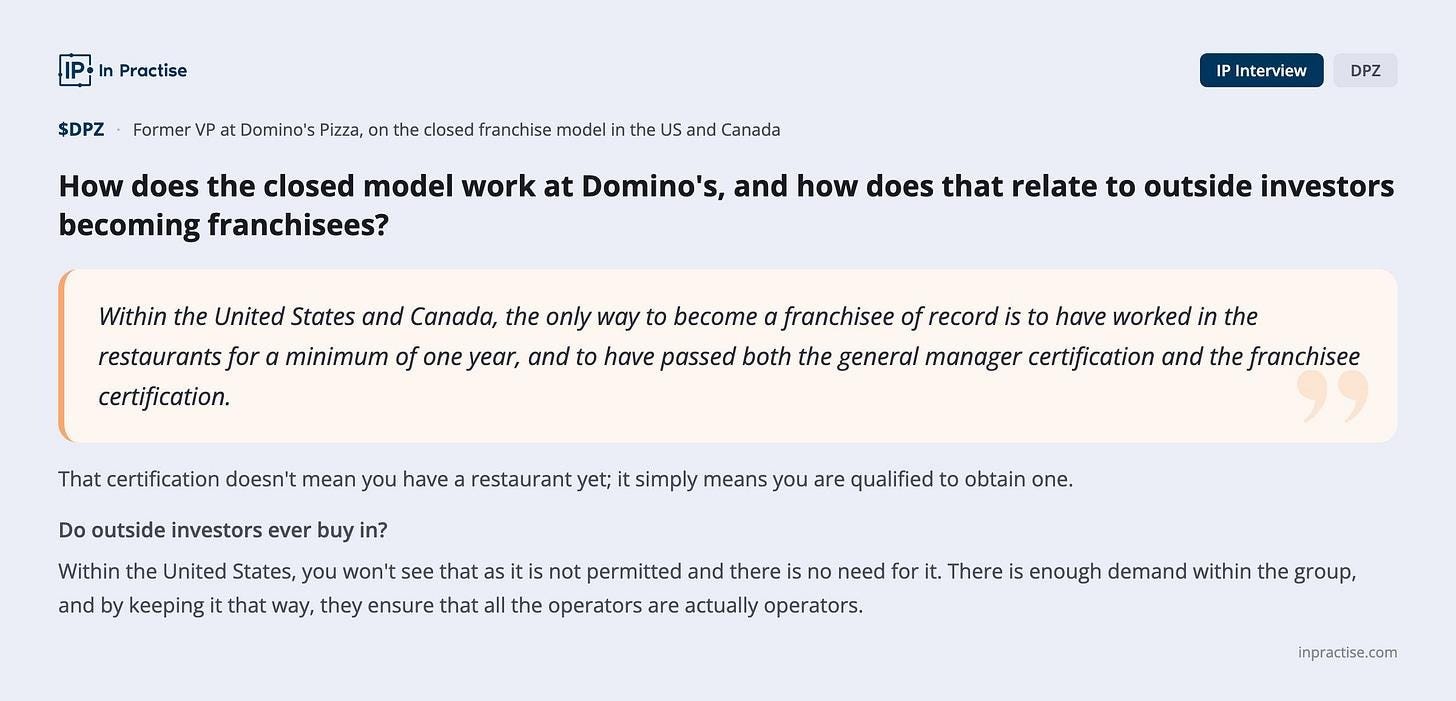
That rule creates a visible ladder. If you start in a store, learn the job and perform well, you can save enough to own one.
It also lowers execution risk. A new owner already knows how to schedule a shift, bake a pizza, control food costs and push for faster delivery. The store does not start from zero on day one.
Inside Domino’s, that path creates an intense culture. The company even runs pizza-making championships. Competitors train for months. Some design custom ladles and rehearse each hand movement to shave seconds from the clock.
This is not a soft HR program. Domino’s has turned speed into a craft.
Technology
Domino’s third system is technology to speed up the process. You know the Pizza Tracker and the ordering app. But it goes beyond what the customer sees.
Domino’s has also invested in automated dough production. At its Indiana facility, machines help measure, move and stack the dough, taking work out of a process that has to be repeated at enormous scale.
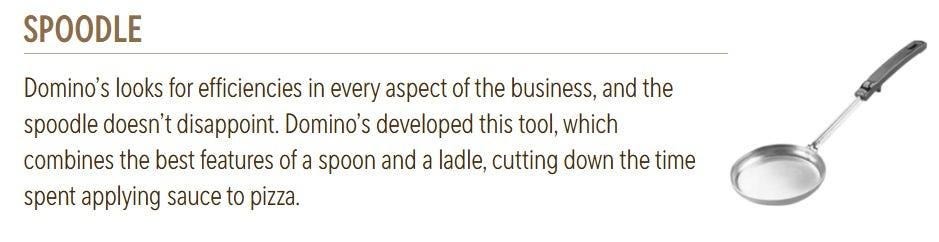
The company also created the spoodle, part spoon and part ladle. A worker can portion and spread sauce with one tool. It saves only seconds, but seconds matter when you repeat the move millions of times.
Domino’s controls the order, production and delivery flow. That gives it decades of data.
In Australia, the local master franchisee, Domino’s Pizza Enterprises, has said its technology can predict whether an online customer will complete a purchase with up to 98% accuracy. That gives stores a head start on preparing orders before checkout is complete.
In September 2019, the Domino’s Eatons Hill store in Brisbane reported an average delivery time of 4 minutes and 58 seconds for an entire week. That was one store’s result, but it shows how far the process can be pushed.
Keeping control of delivery is part of that approach. When the US business announced its Uber Eats agreement, it said those orders would still be delivered by Domino’s drivers. Customers could order through another app while Domino’s continued to handle the delivery itself.
Why people order Domino’s
We now know what Domino’s wants: get a cheap, hot pizza to you fast.
But why do you order it?
Clayton Christensen, author of The Innovator’s Dilemma, framed it differently: think about products as things people hire for a job.
A pizza does one of two jobs.
Feed a group right now, with almost no planning or debate
Feed you or your family without the risk of a long wait or a bad surprise.
Think about the last time you ordered Domino’s. It would fall into one of these two categories.
If friends gather at your house for a match or a party, choosing food can become a negotiation. You want everyone to find something they will eat. More than that, you do not want the food to become the event.
You want to place the order, trust the clock and return to your guests.
The other moment is quieter. It is Wednesday night. You did not plan dinner. You are hungry now. Cooking feels like work, but restaurant prices feel too high. You want something close to the cost of cooking and much easier.
Domino’s has spent decades removing friction from those two moments. The app cuts the order to a few taps. The tracker shows you where the pizza sits. Fortressing cuts minutes from the drive. The supply chain holds down costs. Store contests train people to move faster. Forecasting helps the kitchen prepare.
All of it makes the decision feel small.
Why your mind reaches for Domino’s
When hunger hits, Domino’s still has to beat the pizza shop down the road, the freezer aisle and every restaurant on Uber Eats.
There are four psychological tendencies at play here.
Operant Conditioning - When an action gives you a good result, you repeat it. If Domino’s arrives hot and on time, your last order trains your next one. Amazon benefits from the same loop. It is also the same reason you automatically open the Amazon app to buy something. Consistent behaviours get reinforced.
Doubt-avoidance tendency - It’s a natural human tendency to dislike uncertainty. When faced with confusing or unclear situations, we try to make quick decisions just to feel mentally settled. On a busy night, you may not search for the best meal. You may choose the meal most likely to arrive without trouble.
Availability Bias - What you see comes to mind first. More stores mean more signs, delivery cars and branded boxes in your neighbourhood. When you open an app, Domino’s already sits in your head.
Conflict Avoidance - We are conflict-avoidant creatures. A group does not want a food debate when there is a game going on. Pizza is the familiar, low-risk answer.
When these psychological tendencies play together, they form a powerful force. Charlie Munger called this the Lollapalooza effect, when several tendencies reinforce one another.
Some argue that food apps weaken Domino’s delivery model advantage. That is true, but only up to a point. You often hire Uber Eats to browse. You hire Domino’s when you want certainty.
The competition also includes the ready-to-eat meals you can throw in an oven, or a meal you can cook yourself in twenty minutes.
If delivery times fall by another two or three minutes over the next decade, a Domino’s pizza could arrive in 15 to 20 minutes. That puts it close to the time it takes to heat a frozen pizza.
You will not eat pizza every day. But when dinner becomes a problem you need to solve now, Domino’s becomes hard to reject.
Competition
Domino’s still has to compete on price, and customers have plenty of alternatives. We think its advantage is being able to offer those prices while keeping franchisees profitable. CEO Russell Weiner explained the argument on the Q1 2026 earnings call:
Competition within the QSR pizza space also increased in Q1 as the national pizza players offer deals comparable, if not identical, to the renowned value Domino’s has made famous. While this created some short-term pressure, we believe Domino’s wins in the sustained value environment. Our advantage is profit power, the ability to offer compelling ongoing value while driving profit growth for Domino’s franchisees.
Our industry-leading advertising budget drives the order counts needed to make this value model work profitably over time. Our pizza competitors simply don’t have that same capability. As a result, we believe that when competitors match our value, it places significant pressure on their franchisee economics. Over time, we expect this pressure to contribute to more store closures on top of the roughly 450 closures our 2 public pizza competitors have already announced for 2026. I believe these dynamics will translate into more sales, more stores and more profits for Domino’s franchisees.
We think that’s a reasonable argument, though competitors closing stores won’t automatically send all of those orders to Domino’s. And the latest numbers show why we wouldn’t get carried away: in Q2 2026, US same-store sales grew just 0.1%, while international same-store sales fell 0.1% excluding currency. We still need to see those advantages translate into profitable growth.
Valuation and buybacks
That brings me back to what first caught my attention: how much of the business is left for each share. The share count has fallen from roughly 48 million to 33 million over the past decade, a reduction of about 31%. Even fairly modest profit growth can look a lot better per share when that keeps happening.
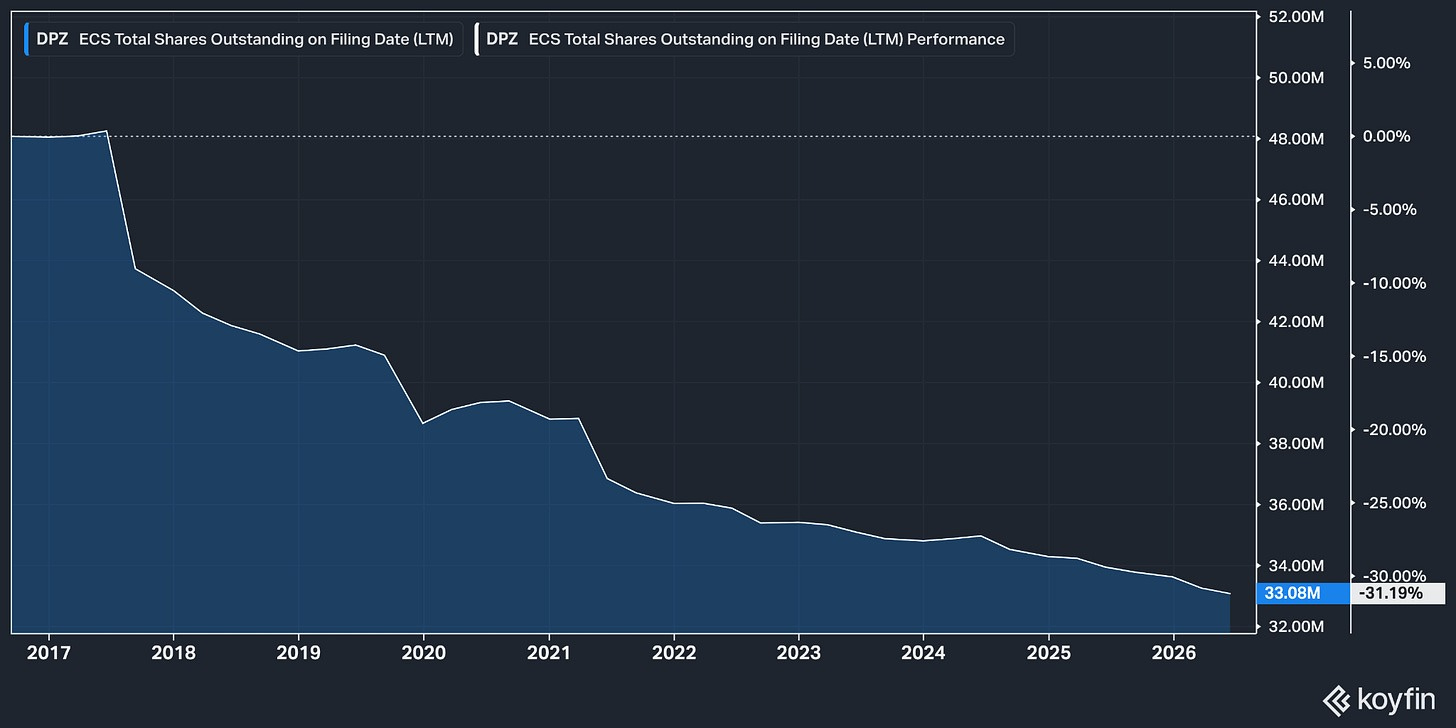
In FY25, for example, net income grew 3.0% while diluted EPS grew 5.3%. Repurchases helped bridge that gap. This is part of what appealed to me about Dropbox too: a business can reward its shareholders without suddenly becoming a fast grower.
Domino’s spent $354.7 million retiring 785,280 shares in FY25, an average of about $452 a share. At $312, the same amount of cash would buy roughly 45% more stock. Assuming the business holds up, we’d be quite happy for repurchases to continue at these prices.
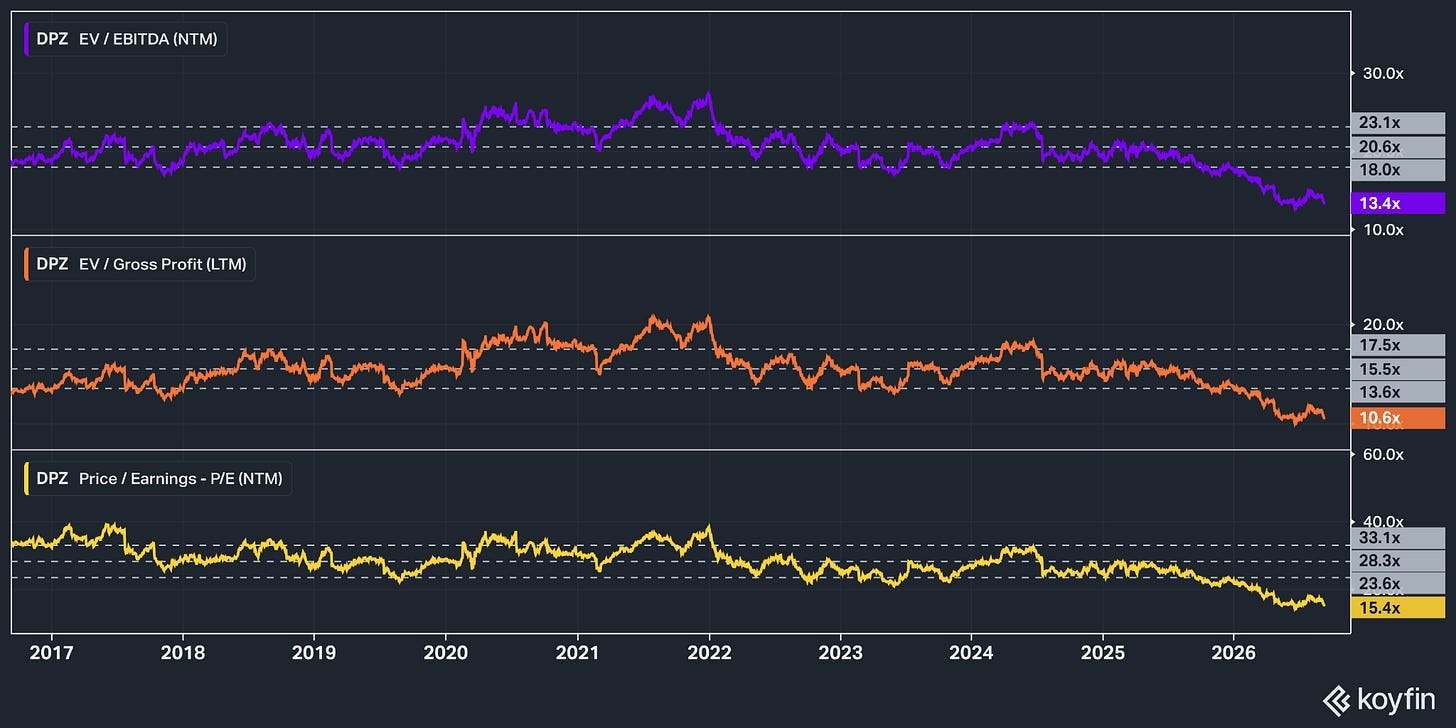
At roughly $312 per share, the stock trades at 17.8x FY25 diluted earnings of $17.57, or $601.7 million in net income. The forward P/E in the chart is lower at about 15.4x because it uses the next twelve months’ expected earnings. Those estimates still have to be earned.
The FY25 earnings figure is after the $193 million of supply-chain profit sharing. We’d leave that out of any estimate of what shareholders earn. It is a recurring obligation to the franchise network, recorded as a reduction in revenue. Those payments help support the store economics we like, and we can’t also count them as cash available to DPZ shareholders.
Over a few years, we think 4–5% annual net income growth is a reasonable assumption to work with. Same-store sales growth of around 2%, alongside 2–3% net store growth, could support that, provided margins and financing costs cooperate. That does require better same-store sales than we just saw, and adding stores won’t translate dollar for dollar into higher profits.
If net income grows 4–5% and the share count falls 2–3% a year after new issuance, earnings per share would grow roughly 6–8%. The current $1.99 quarterly dividend adds $7.96 a year, or about a 2.5% yield at $312. Put those together and we get roughly 9–11% annual returns if the earnings multiple stays around today’s level and the dividend keeps pace with earnings.
That assumes the buybacks remain affordable. Domino’s generated $671.5 million of reported free cash flow in FY25, after capital spending. It also ended Q2 2026 with about $4.8 billion of securitized debt and a reported leverage ratio of 4.3x adjusted EBITDA. Servicing and refinancing that debt come before buying back stock. If interest costs rise or franchisee profits weaken, there may be less cash available to retire shares.
We can see a path to 13–15% if profit growth is stronger or investors eventually pay a higher multiple. We wouldn’t make that the base case, and a lower multiple could drag returns below the range above. What we like at this price is that modest growth, a dividend and a shrinking share count could still produce a worthwhile result. We’re more interested in whether Domino’s can keep doing that for years than in whether the stock gets back to its highs any time soon.
Disclaimer: This article is for informational purposes only and does not constitute investment advice. Always do your own due diligence before making investment decisions.

Nah. Consumer stocks and especially non health focused stocks suck rn
You might also consider that their pizzas are basically disgusting. Financial engineering can't salvage a bad product.