


I was going through my watchlist recently and Dropbox of all names caught me off guard.
The stock is trading at roughly $36 at the time of writing. I’m used to seeing it somewhere around $25. That’s basically where Dropbox has traded for most of the past five years.
I have followed the company on and off since 2020 and owned it twice during that stretch. Both times I sold because I found something I liked better. Nothing really broke at Dropbox. It was just easy to move on from a stock that never seemed to do much.
I last wrote about Dropbox in October 2025. Growth had basically stopped by then, but customers were sticking around and the company was still generating a lot of cash.

The thesis was pretty boring... Dropbox had a sticky product, almost no growth, strong margins, a lot of free cash flow, and management was using a ridiculous amount of that cash to buy back stock.
The buyback was really the whole reason I liked it. Dropbox didn’t really need to grow all that much if the core business stayed stable and management kept making the share count disappear. It was becoming a genuine share cannibal, and the stock sitting in the same range year after year was actually helping.
At the end of that post, I said I wanted to see a few more quarters of flat revenue, strong cash flow, and continued buybacks before starting a small position.
Dropbox gave me almost exactly that. I still never bought it.
Now the stock is near the highest level it has traded in years, so I wanted to go back through the original thesis and see what actually happened.
So did the thesis work?
For the most part, yes.
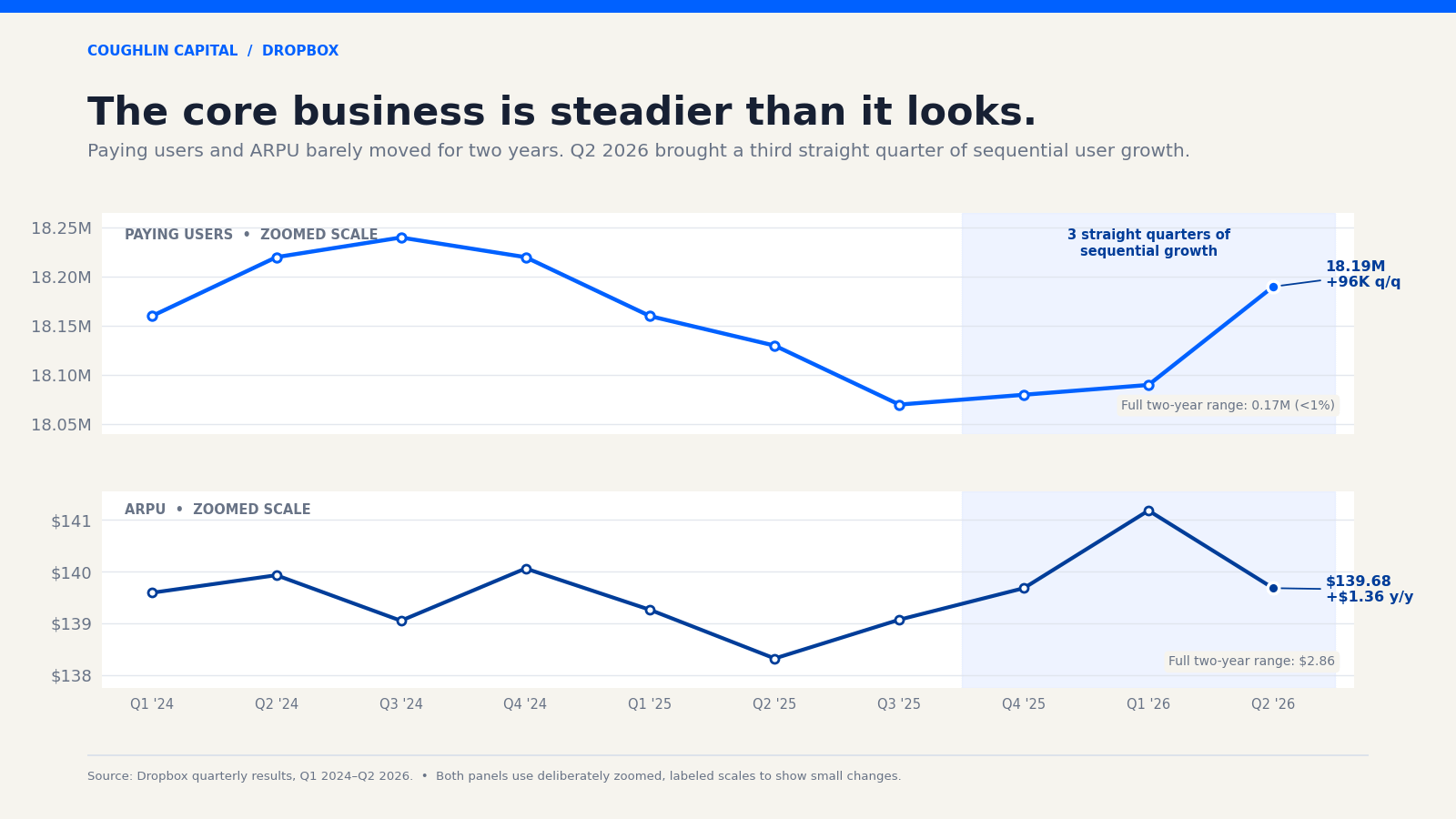
The core business looks pretty much the same as it did when I last wrote about it. Revenue has stayed around $2.5 billion and the business excluding FormSwift has returned to slight growth. Dropbox has now added paying users for three straight quarters, while average revenue per user is still sitting around $140.
That is really all I wanted to see. I do not care whether core revenue grows 1% or 2% in a given quarter. The question was whether Dropbox could hold onto its users and pricing while Microsoft, Google, and Apple continued bundling storage into their much larger ecosystems. So far, it has.
There are now 18.19 million paying users, up 96,000 sequentially in the latest quarter. ARPU was $139.68, compared with $138.32 a year ago. Management expects some pressure as its cheaper Simple plan becomes a larger part of the mix, which is fine if that plan attracts and retains more users. I would only become concerned if the user growth is coming entirely from cheaper plans while the higher-value customers keep leaving.
Cash flow has also held up. Dropbox generated a little over $1 billion in unlevered free cash flow last year and now expects at least $1.07 billion in 2026. The company is still producing roughly $1 billion of cash from a revenue base that barely grows.
More importantly, it is turning that cash into much better results on a per-share basis.
Dropbox repurchased 60.4 million shares in 2025 and another 26.9 million during the first half of this year. Diluted shares were down roughly 18% year over year in Q2, which helped drive a 25% increase in unlevered free cash flow per share.
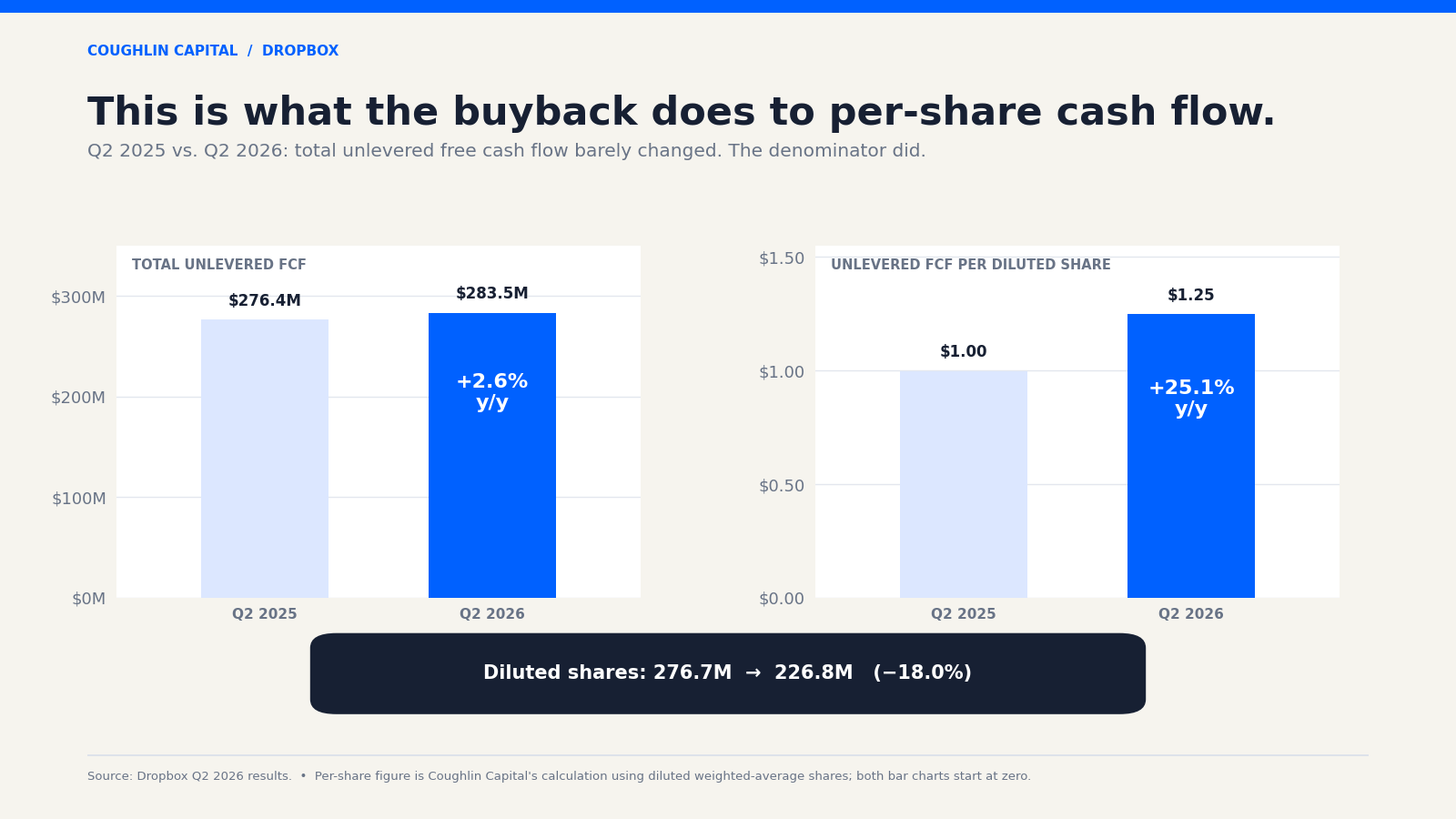
That is basically the entire thesis.
Dropbox does not need to grow much when every remaining share represents a meaningfully larger piece of the business each year. I originally figured the company might reduce its share count by 6% to 8% annually. It has been moving much faster than that. The diluted share count has fallen from roughly 419 million in 2020 to about 227 million in the latest quarter.
That is nearly half the company gone in six years.
The board also added another $900 million to the buyback authorization in June, leaving about $1.4 billion available at the end of Q2. Against a market cap of roughly $8 billion, that is still a massive amount of firepower.