


Big week for China tech. Again.
Baidu reports Tuesday morning, Kingsoft Cloud follows Wednesday, and Alibaba reports Thursday. PDD is currently expected next Monday, although the company still has not officially confirmed the date, which is very helpful.
Here is the order:
Tuesday: Baidu ($BIDU)
Wednesday: Kingsoft Cloud ($KC)
Thursday: Alibaba ($BABA)
Monday, August 24: PDD ($PDD), expected but not officially confirmed
Each report gives us a slightly different look at what is happening in China tech. Baidu and Kingsoft Cloud should tell us more about AI and cloud demand. Alibaba gives us cloud, e-commerce and quick commerce in one report. PDD should help fill in the remaining pieces around domestic e-commerce market share.
I cover Baidu and Alibaba much more closely, so that is where most of my attention will be.
We already got a few early clues from Tencent and JD last week.
Tencent’s advertising revenue grew 22%, AI demand remained strong and capex jumped again. JD’s report may have given us an even more useful signal for Alibaba.
JD is still the third and smallest player in quick commerce behind Meituan ($MPNGY) and Alibaba ($BABA), so I do not want to read too much into one quarter. But profit jumped and food delivery losses narrowed quite a bit, which suggests the price war across e-commerce and quick commerce has cooled.
That lines up with Alibaba’s pre-earnings guidance. Management has already told the Street that quick commerce losses are falling faster than expected and e-commerce margins are improving.
Put those together and the early read is that the price war has finally started to cool quite a bit.
That should help margins across the entire e-commerce and quick commerce market, including Alibaba, Meituan and JD. Alibaba may have the most room to improve given how much it has been spending, but the signal is good for the whole group.
Baidu
Baidu reports Tuesday morning.
The main things I am watching are Cloud growth, guidance and margins. More importantly for the stock, I want details on the Kunlunxin chip spinoff.
Last quarter, Baidu’s AI-powered business generated RMB 13.6 billion in revenue, up 49%, and crossed 50% of General Business revenue for the first time.
AI Cloud Infrastructure grew 79%. GPU Cloud revenue grew 184%.
Those are massive numbers, although I obviously do not expect Cloud to grow 79% forever. What I want to hear Tuesday is whether demand remains strong, what the pipeline looks like and how management is thinking about growth through the rest of the year.
The margin commentary will be important too. Baidu is spending heavily to build capacity, so I want some evidence that the economics are improving as the business scales. Another big Cloud number would be great, but guidance and margins will probably tell us more than the reported beat or miss.
Meanwhile, online marketing revenue fell 22% last quarter.
Baidu does not need search advertising to suddenly return to strong growth. It does need the decline to become less ugly while AI takes over more of the business. Another 20% drop would leave Cloud doing even more of the work.
Then there is Kunlunxin.
I think this is probably the biggest piece for the stock right now. In January, Baidu officially announced that Kunlunxin had confidentially submitted an application for a proposed spinoff and separate listing in Hong Kong. Baidu expects Kunlunxin to remain a subsidiary after the listing.
Since then, The Information reported that Kunlunxin is targeting a $50 billion IPO valuation. Reuters could not independently verify that figure, and Baidu has not confirmed it, so I would treat it as a target.
Baidu reportedly owns around 58% of Kunlunxin. The basic math would value that stake at roughly $29 billion if Kunlunxin actually lists at $50 billion. That calculation ignores dilution from the IPO and any holding-company discount, but it would still represent a huge portion of Baidu’s current market value.
For context, Kunlunxin’s December funding round valued the company at only about $3.1 billion. Going from $3 billion to $50 billion within a year would be fairly ridiculous, so I am not plugging the full $50 billion into my valuation and calling it a day.
The official filing also says that the offering size, structure and Baidu’s ownership after the deal have not been finalized. The listing still requires regulatory approvals, and Baidu has given no firm timetable.
That is why management’s commentary could be so important Tuesday. I want any update they can give on timing, the potential offering size and how much of Kunlunxin Baidu expects to own afterward. Even if the final valuation comes in well below $50 billion, a completed listing would finally give the market a cleaner way to value an asset that is mostly buried inside Baidu today.
Kingsoft Cloud
Kingsoft Cloud reports Wednesday morning.
I do not follow the company closely enough to pretend I have some big opinion on the stock, but the report should give us another useful look at AI infrastructure demand in China.
Q1 revenue grew 37%, public cloud revenue increased 48%, and gross billings from AI customers grew 90%. AI represented more than half of public cloud revenue for the first time.
The weak part was gross margin, which fell from 16.2% to 12.8% as server costs and investment increased.
Demand clearly has not been the problem. I want to see whether margins begin stabilizing as all of this new capacity comes online.
For me, Kingsoft Cloud is mostly a read-through for Baidu and Alibaba. Strong AI demand would be another sign that China’s cloud buildout still has plenty of room to run.
Alibaba
Alibaba reports Thursday morning, and this is the one I care about most.
The two biggest numbers for me are Cloud growth and Cloud adjusted EBITA margin.
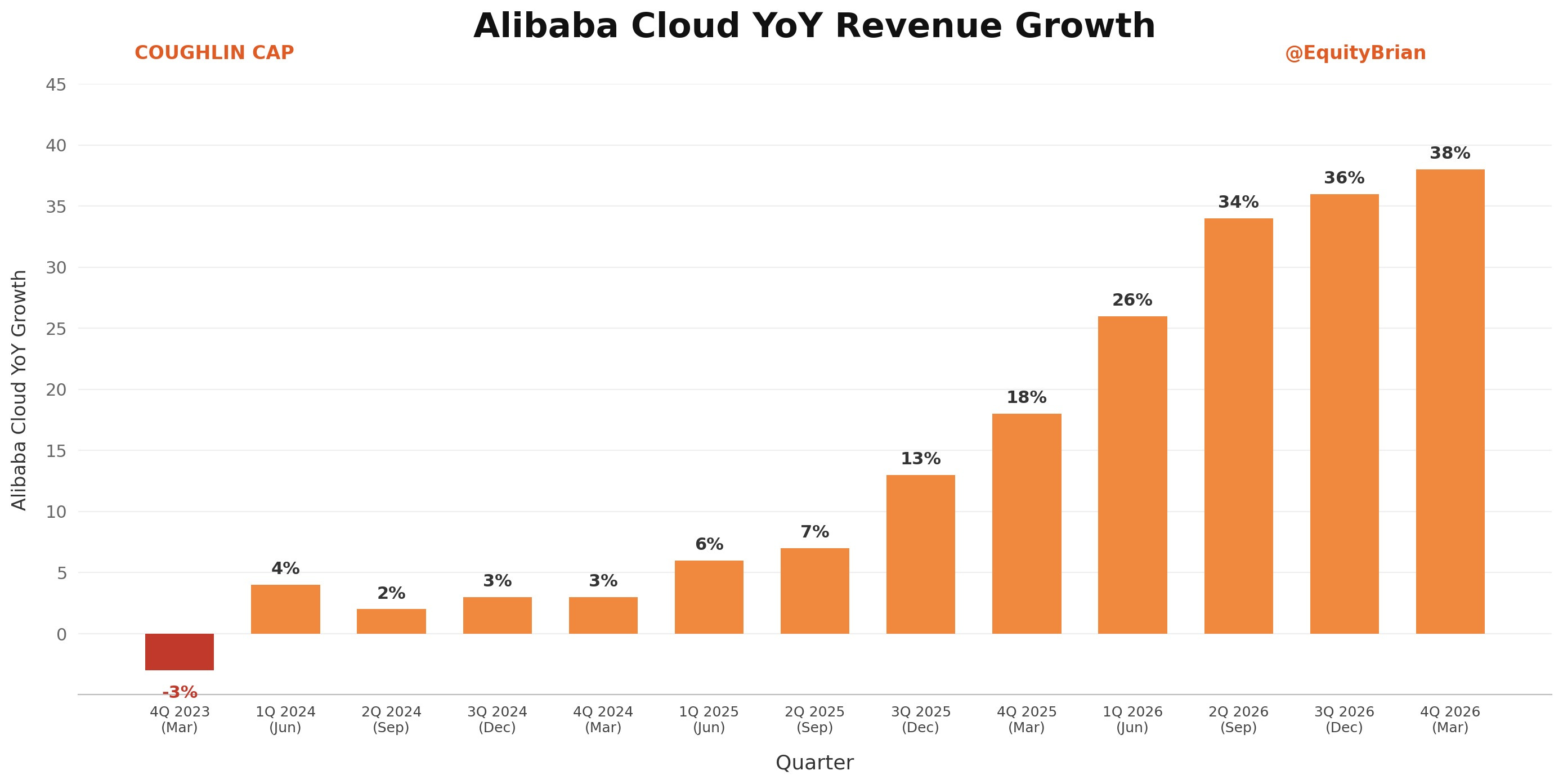
I think Cloud revenue grows more than 45%. Parts of the sell side are already around the same number, so this is no longer some wild estimate that nobody expects.
Cloud growth has accelerated from 29% to 34%, then 36%, and most recently 38%. AI-related products accounted for 30% of external Cloud revenue last quarter, and management expects that figure to exceed 50% within roughly a year.
I think the bigger surprise could come from margins.
Alibaba Cloud’s adjusted EBITA margin has been stuck in the high single digits while the company invests aggressively in capacity. Last quarter, it was around 9%.
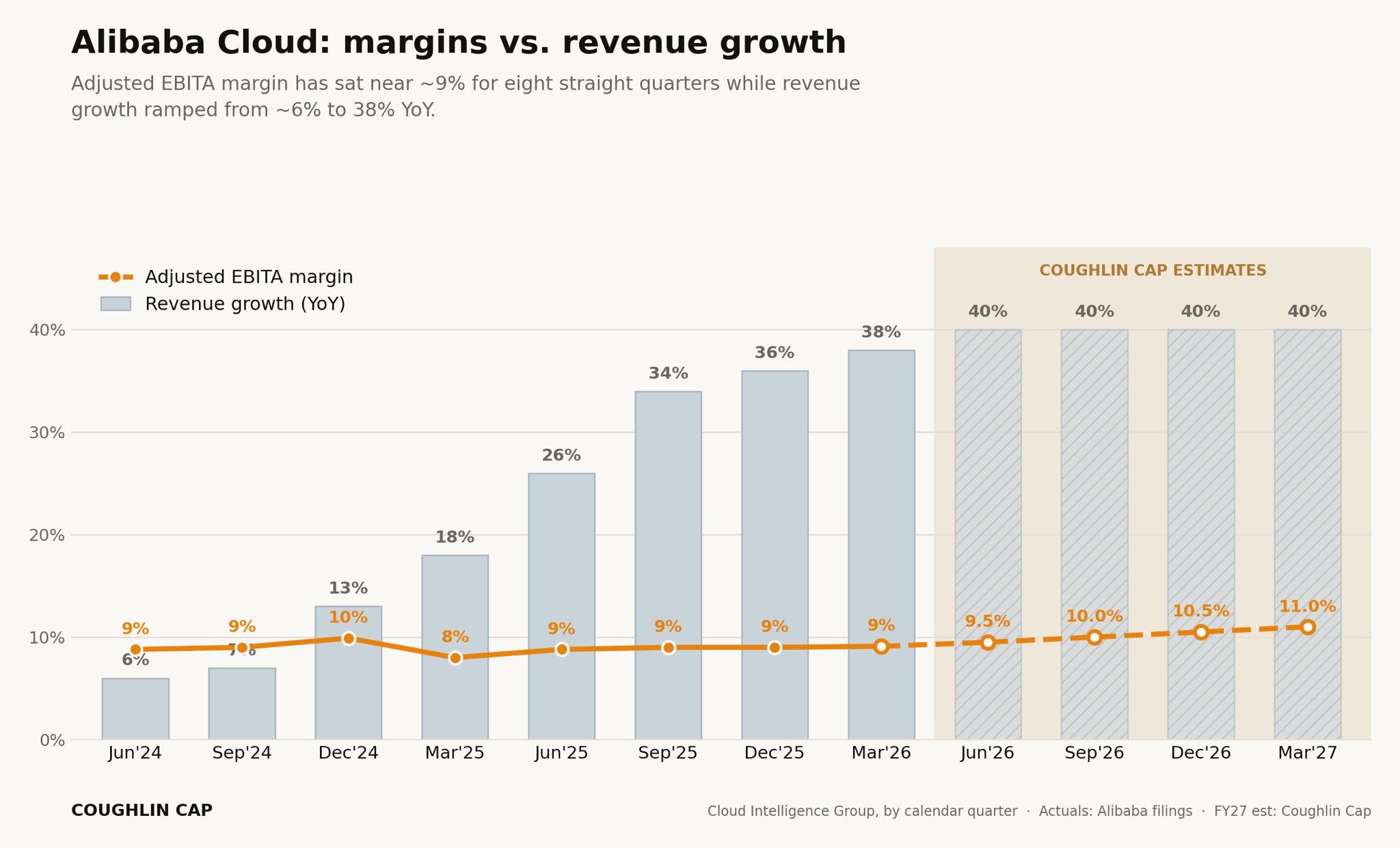
Management said margins should improve over the next one or two quarters. I think we could see Cloud EBITA margin move back into double digits for the first time in years.
That would be huge.
Cloud has been growing quickly for a while, but the market has been reluctant to give Alibaba much credit because margins were barely moving. That concern has been fair. Revenue growth only goes so far if the company has to consume every dollar building more capacity.
A 45%+ Cloud print with double-digit EBITA margins would show that some operating leverage is finally showing up. I think that combination could force investors to value the Cloud business very differently.
If Cloud grows quickly and margins remain stuck around 9%, I will want to understand why. This is the quarter where we should begin seeing some of the improvement management has been talking about.
Quick commerce is the other big piece.
I wrote in July that management’s pre-earnings calls were noticeably more positive than the calls held before the previous quarter. Quick commerce losses were apparently falling faster than expected, and management wanted the Street to understand that the June quarter should look better than feared.
Alibaba gave analysts the opposite message back in January. Management told them to lower estimates across Cloud, e-commerce and margins, and the quarter eventually came in pretty close to those warnings.
So I take the change in tone seriously.
The core e-commerce business still needs to hold up, but I think the stock reaction will mostly come down to Cloud growth, Cloud margins and how quickly quick commerce losses are falling.
Expectations have moved higher. The stock has bounced sharply from its June lows, 45% Cloud growth is now being discussed openly and investors already know quick commerce is improving.
A 40% Cloud print would normally look great. This time it could be viewed as a disappointment.
But if Alibaba reports 45%+ Cloud growth, moves Cloud EBITA margins into double digits and shows a real reduction in quick commerce losses, I think the stock goes quite a bit higher.
I am very bullish heading into the print.
PDD
PDD is currently expected to report next Monday, although we are still waiting on an official date.
The main thing I want from this report is a better idea of where e-commerce market share sits between PDD, JD and Alibaba.
All three companies have been spending heavily. Alibaba attacked quick commerce, JD moved into food delivery and PDD is increasing investment in its supply chain and first-party brand business.
Last quarter, PDD’s revenue grew 11% and transaction services revenue increased 20%, but net income fell 15%.
Management made it clear that investment will remain high, even if near-term profits take a hit.
PDD does not make market share easy to calculate, so we will have to piece it together using its results alongside what JD and Alibaba report. If PDD’s domestic growth slows while Alibaba’s GMV and customer management revenue improve, that would be a pretty good sign that share is moving.
If all three report strong domestic demand, then maybe the Chinese consumer is doing better than people think.
Temu will get plenty of attention too, especially around tariffs and its international expansion. For me, the more useful part will be what PDD tells us about competition inside China.
By the time PDD reports, we should have a much cleaner picture of Cloud demand, AI spending and e-commerce market share across China.
For Alibaba specifically, this could be the quarter where Cloud finally earns a different valuation. Margin expansion has been the missing proof point for me and probably for the market too.
We will find out Thursday.
Disc. Long BABA 0.00%↑ & KWEB 0.00%↑
Disclaimer: This post is for informational purposes only and should not be considered financial advice. I am not a financial advisor. Please do your own research and make your own investment decisions.
Agree with you that cloud margin expansion into the double digits will be the main catalyst for pushing shares higher. Most of $BABA’s intrinsic value in the future will be their cloud business as their new core profit center. Imagine 10-years out without a delisting and 20% cloud margins on $300b in revenue. Conservative estimates for top line but I do think 20% margins could be aggressive but we’ll see. New mgmt has the right mentality on ROIC for shareholders