


What if I told you there’s a company used by nearly everyone in its country (15M users out of 20M people) with ~68% ROE, ~67% EBITDA margins, and ~30% revenue growth that trades at just ~6x earnings?
You’d probably ask what’s wrong with it. The answer: it’s in Kazakhstan.
I get it. Kazakhstan doesn’t exactly scream exciting. But sometimes the best deals hide in places nobody wants to look. Kaspi is one of those deals, a digital payments and e-commerce monster that dominates its home market and just bought its way into Turkey, a market four times larger.
The stock trades like the business is dying. It isn’t. Revenue grew ~32% last year. Net income grew ~25%. The company generates a ton of FCF. Management owns nearly half the business and recently paused dividends to fund expansion rather than chase quarterly numbers.
Yet it trades at ~2.6x EBITDA. That’s not a growth multiple. That’s not even a value multiple. That’s a “the world is ending” multiple.
I like simple stories with sturdy math. Kaspi is one of those. It runs the payments rails, the main marketplace, and a high-margin lending engine for an entire country. It is expanding that model into a market four times larger. Returns on capital are elite. Costs are controlled. Management actually behaves like owners. Yet the multiple looks like the market is bracing for a collapse.
That is the whole pitch. A dominant utility with software margins, selling at a value multiple, run by people who have earned the right to reinvest.
1.) Business Overview
Kaspi runs the financial operating system of Kazakhstan. It’s not a “fintech” or a “bank” or an “ecommerce platform.” It’s all of those, built into one app that people open dozens of times a month.
The company runs two platforms that meet in the middle. Kaspi.kz is for consumers. Kaspi Pay is for merchants. Everything flows between the two.
On the consumer side, Kaspi.kz is where you move money, pay bills, send transfers, order groceries, book travel, or buy something on credit. For most people in Kazakhstan, it’s the default app for daily life. Monthly transactions per active consumer sit around the mid-70s. That is the kind of engagement you get when a product becomes infrastructure.
On the merchant side, Kaspi Pay is the all-in-one control center. A store can accept QR payments, advertise products, take out a small business loan, and ship through Kaspi’s own delivery network—all from one screen. That’s why small merchants love it. It saves them time and paperwork, and it pulls real customers in every day.
At the core are three interconnected engines—Payments, Marketplace, and Fintech—that reinforce one another.
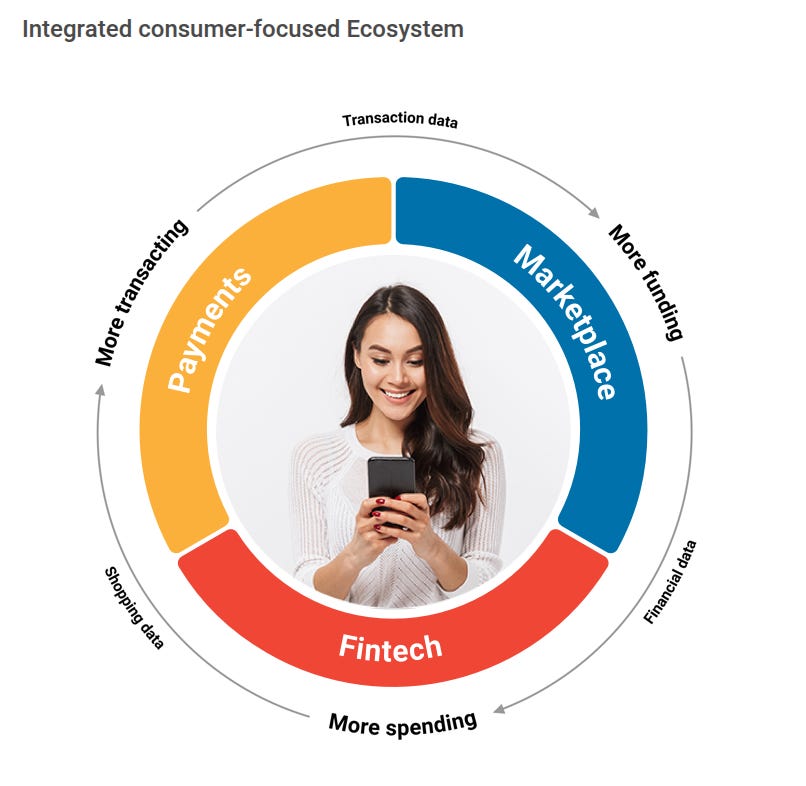
Payments is the foundation. Kaspi processes nearly all QR transactions in Kazakhstan. The model is simple: every time money moves through the system, Kaspi earns a small cut. The key is frequency. Payments happen every day, which drives constant engagement and mountains of data. That data feeds everything else. As management likes to say, once the network is built, “operational gearing” takes over—the next transaction is almost pure profit.
Marketplace is where the monetization gets interesting. It’s not just a take-rate on GMV. It’s delivery fees, ad placements, and logistics services that layer onto the commerce flow. As the network grows denser, each order becomes cheaper to fulfill, and ad spend becomes more effective.
Fintech closes the loop. The lending engine sits directly on top of the payments and commerce rails. On the consumer side, you can split a purchase into installments right in checkout. On the merchant side, you can borrow against live sales data. There’s no guesswork, because Kaspi already sees every transaction. Loss ratios stay low because credit isn’t being issued blindly—it’s issued inside a closed ecosystem where repayment history and purchase behavior are visible in real time.
Then there’s logistics, the quiet advantage that keeps everything working. Kaspi built thousands of parcel lockers and a nationwide courier network that reaches nearly every city. It’s not just a cost center. It’s the glue that keeps the marketplace credible. When deliveries are reliable, customers buy again, merchants advertise more, and the whole system hums.