


A few weeks ago I wrote that Q2 was probably going to be ugly for Coupang.
Well, it was.
The margin recovery will take longer than I expected. But the customer behavior looks much healthier than the headline numbers suggest, and I can live with the first if the second keeps holding.
So yeah, there’s plenty here to complain about.
But I actually came away from the quarter feeling better about the part of the thesis I care about most.
The breach happened last November, and Q2 was really the first quarter where most of the fallout showed up at once. The fine was booked. Marketing spend stayed elevated as they tried to win customers back. The logistics network was built for demand that temporarily disappeared. And you still have a chunk of customers who stopped buying after the breach and haven’t returned.
Against all of that, the underlying business held up better than I expected.
Revenue
Revenue was $8.86 billion, up 4%, which came in about $170 million light of consensus. That number is close to useless.
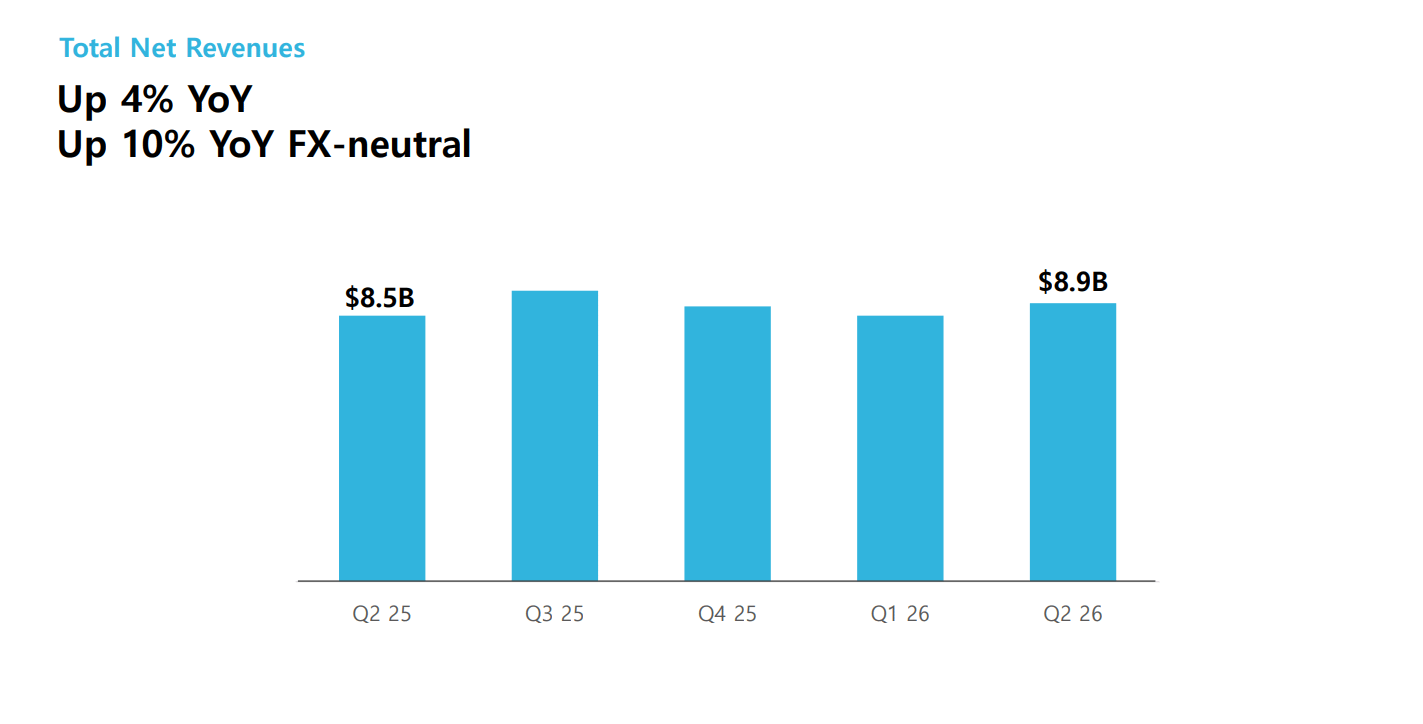
The won hit its weakest level against the dollar in more than fifteen years during the quarter. Translating Korean revenue back into dollars took $548 million off the top line. In constant currency the business grew 10%. Product commerce grew 8% in constant currency, up from 5% in Q1.
Nothing to do about that. I own a Korean business that reports in dollars, so some quarters the currency helps and some quarters it doesn’t. What I care about is whether Koreans are buying more stuff from Coupang, and in local terms they are, at a faster clip than three months ago.
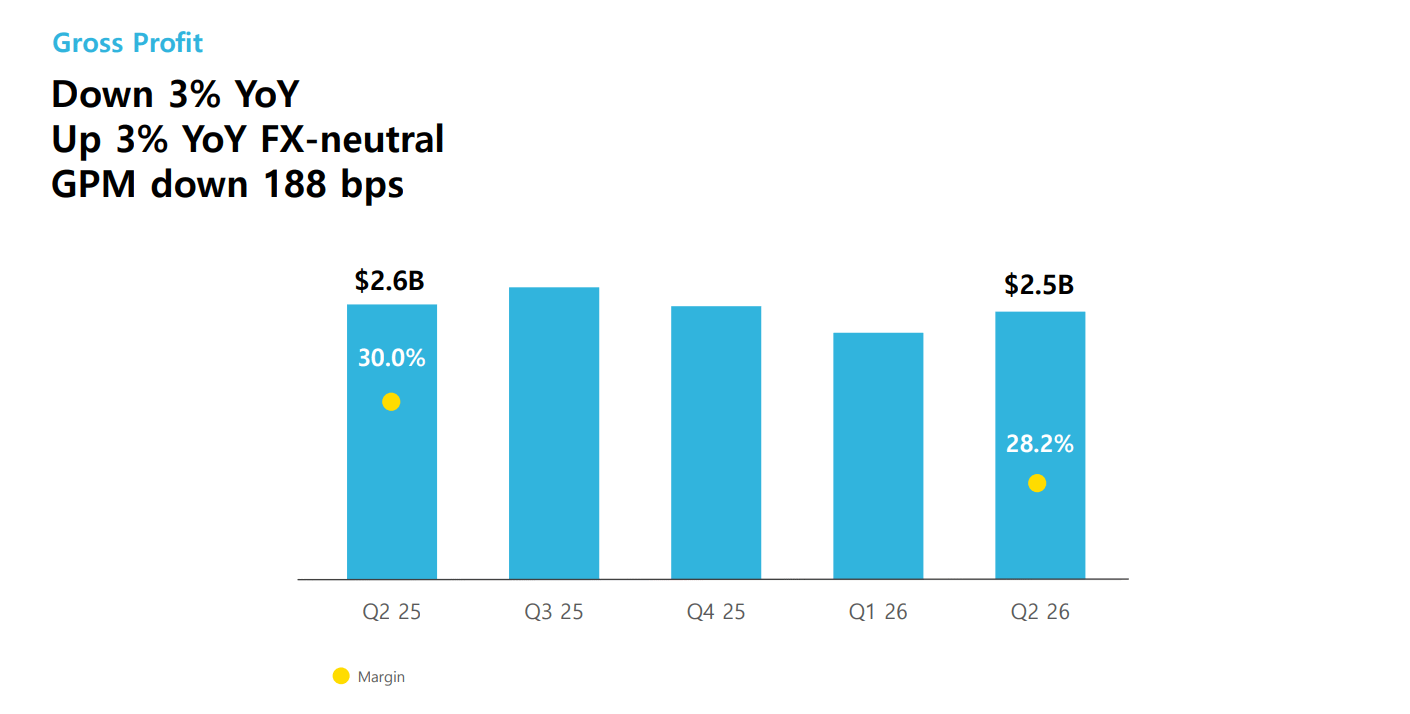
Gross profit was $2.49 billion, down 3% reported and up 3% in constant currency, with margin down 188 basis points to 28.2%.
Customers
The thing that actually got my attention was buried in Bom Kim’s prepared remarks.
If you strip out the specific group of customers who stopped buying during the breach and still haven’t come back, spending across everyone else grew about ~16% year over year. That is roughly what product commerce was compounding at before any of this happened.
“The vast majority of our customer spend never moved. That group is spending at the highest levels in our history and compounding similarly to before last year’s data incident.” — Bom Kim
He also put a number on the older cohorts that I hadn’t seen before. They now spend nearly ten times what they spent in their first year, and they’re still increasing. That’s the part of this business that never shows up in a quarterly print and is most of the reason to own it.
The customers who left and came back apparently return at their full prior spend and grow from there. New customers are signing up faster than they were before the incident. WOW membership is above where it was pre-breach with additions accelerating, though new members start at the bottom of the spend curve, so that shows up in revenue later rather than now.
I’m aware of what this metric is. When a company hands you a growth number that excludes the customers who stopped buying, you hold it at arm’s length. Every business on earth looks healthy once you remove the people who left.
But it does answer the one question I actually care about, which is whether the breach broke anything. If the base that stayed were spending less, or ordering less often, or if WOW were leaking members, that’s where it would show up first. Instead the people who stayed are spending more than they ever have, and the ones who left return at full strength whenever they decide to return.
To me, the missing customers still look angry about the breach. The behavior of the ones who returned doesn’t suggest they found a better service somewhere else. Coupang still has work to do rebuilding trust, but I don’t see much evidence that its actual customer proposition got worse.
Margins
Product commerce adjusted EBITDA margin was 5.1%, down 390 basis points year over year. Segment EBITDA fell $281 million to $382 million. Consolidated margin was 1.8%.
Management points at three things. Supply chain got dislocated when demand dropped. Marketing is elevated because they’re paying to reacquire customers. And the fixed cost base was sized for a demand curve that stopped existing in November, so they’re running a network with slack in it.
That last one was a choice.
“We could cut them significantly, we’ve chosen not to because the right long-term decision is to grow into the capacity and support our customer experience that has always been our North Star.” — Bom Kim